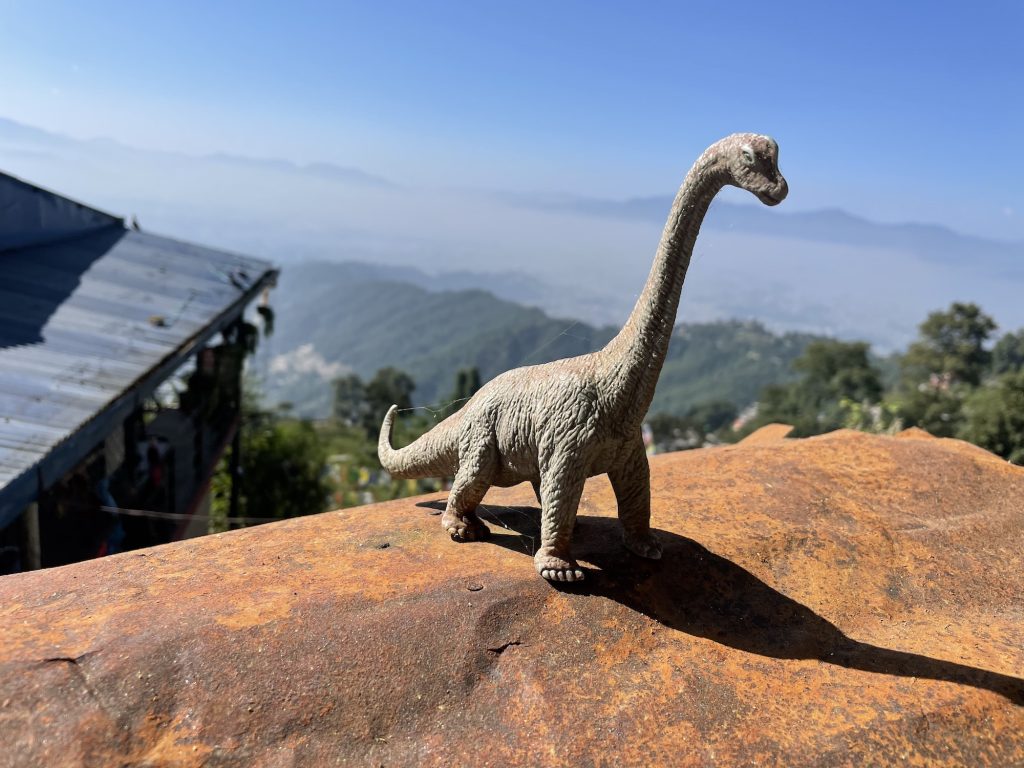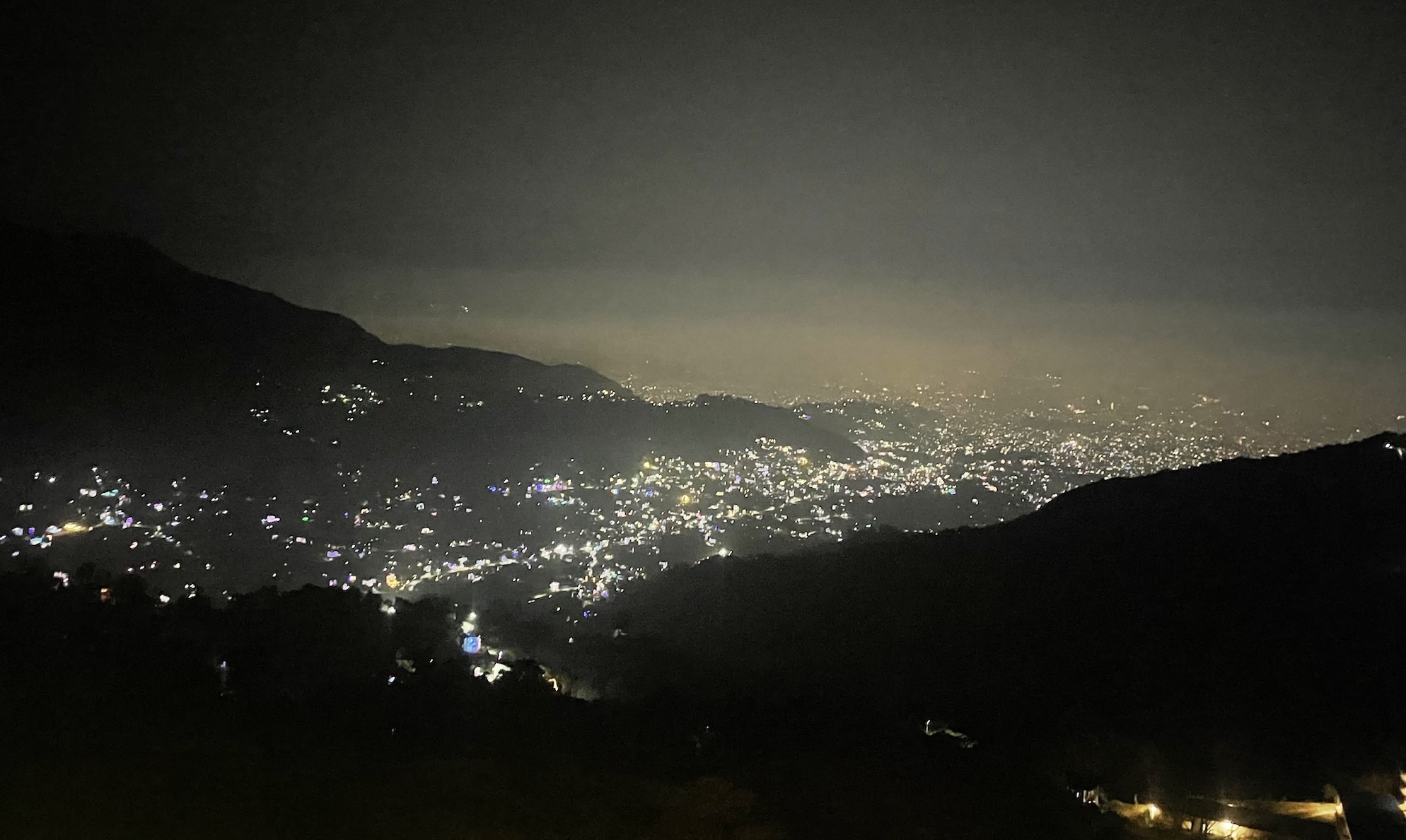
Gokarneswor
The Sahid Smarak Park is set on a hill. In the morning, there, I often heard Om Mane Padme Hum playing out of someone’s phone or bluetooth speakers, a modern rendition with synths. There were people engaged in their ‘morning walk’ (an often used phrase). There were even joggers. The trees were decked with Buddhist prayer flags and the monkeys ran rampant, fighting over refuse, screeching. At its highest point, the park is crowned by a yellow pyramid sculpture named Jagdol, while lower down there is a huge white orb behind gates which only the macaques can breach.
According to a plaque, the orb was built with the help of the Israel-Nepal Friendship Association; it looks like a temple to UFOs. Because Nepal was the first South Asian country to recognise Israel (in 1960), the two states have maintained friendly ties, but Nepal doesn’t support their crimes in the UN. The Himalayan country remains a popular destination for Israeli Defence Force veterans to go backpacking after completing their national service. I didn’t see many Israelis in Sahid Smarak Park, though; foreign tourists were rare in Gokarna. And I wasn’t a tourist—God forbid, I was there to research: Nepal’s growing trail running culture was my reason for having volleyed across the planet. I landed in the roiling criss-cross of ‘KTM’, needing to learn…
There was a gym near my flat, a place called Blink Fitness, but it was so crowded and the music was so loud, thumping Western pop, that I preferred to do my inadequate workouts in the park, even though the mosquitoes were irritating. (If I sweated, which was inevitable, they swarmed about my legs, undeterred by DEET.) Sahid Smarak park had a pull-up bar, dip bars and some logs—the biggest of which, someone told me, weighed about sixty-five kilograms. Sometimes Mira Rai, Nepal’s mountain runner phenom, trained there; everyone knew her. She inducted me in the use of the log, demonstrating a squat press, having learned a lot about strength from her years of injury struggles. Sometimes she would critique my plank and press-up form, stridently; one time she demanded, ‘Do you want to be champion?! I will train you, then you can go back to UK and be champion!’ I couldn’t tell if she was joking.
The proliferation of calisthenics parks is a recent movement in Nepal, spearheaded by an organisation called Nepali Youth Fitness and Calisthenics (NYFC) as part of their so-called Project Temple campaign. The founder of NYFC is a bodybuilder named Sukadev Karki who’d been training for Mr. Nepal when he crashed his motorbike and suffered eighteen fractures, then couldn’t walk for four months. After gradually regaining his fitness, at times against his doctors’ advice, he made it his mission to help youngsters get fit. ‘Nepal is a country filled with Hindu and Buddhist temples,’ he explained in a 2021 interview. ‘Our youths need special temples—places dedicated to physical praying… where young people’s bodies can pray through calisthenics.’
In the Gokarna calisthenics park there were mostly young men, but there was also a guy who might have been in his sixties, apparently a coach to the youth. I’m not sure how formal this arrangement was. I never learned his name; I just called him Daju (a respectful term for an older male). He always seemed impressed by my running, but like Mira was a keen critic of my strength. ‘You have power in your legs but no power in your arms,’ he told me.
Also there, often, were the Zitutsang brothers—twins. They were Tibetans, I think, quite tall and lean. In all honesty, I kept getting them mixed up. One of them was called Tenzin. Today Tenzin’s brother was wearing a fifteen-kilogram weighted vest. He said, ‘With this on, I can only do 4 pull-ups.’ More than me…
I tried to do some chin-ups. I think I managed one or two, and then said to Daju apologetically, ‘I need more practice.’
‘You need a lot of practice,’ he said, and then added, ‘you’re late today.’
Late? He was expecting me?
‘My legs are tired from a long run,’ I explained. ‘Up Shivapuri peak.’
Tenzin’s brother was smiling.
‘Yesterday, he ran all the way to Shivapuri peak,’ Daju related to Mr. Zitutsang.
‘Where is Mira?’ Tenzin’s brother asked.
‘She can’t run at the moment,’ I explained. ‘Only cycling. Meniscus tear.’
‘Oh,’ Daju said. ‘She’s a purano kheladi. She’s been running for many years so she’s getting injuries now.’
A purano kheladi? I translated his words slowly. Purano… old… kheladi… athlete. She’s 36 or something, I thought. A child in ultra-running terms. If she’s a purano kheladi already, what does that mean for me? How long have I got?
My rumination was broken; Tenzin asked me if I liked Nepal, a common question.
‘I do,’ I replied.
‘But,’ he said, ‘Kathmandu’s not great. It’s so dirty. Polluted.’
I had to agree.
A group of youngsters arrived, mainly young men but some young women too, all wearing t-shirts relating to some mountain running event, emblazoned with the words ‘Run for Peace’. Like a lot of running events in Nepal, this one had some nebulous awareness-related agenda built in—or tacked on, depending on how you look at it. Run for this, run for that. Every year there’s a glorious half marathon in Kathmandu from the athletics track to the KFC and back, called the Right to Protein Run. It’s sponsored by the US soybean council, which campaigns for the consumption of soy products in South Asia to remedy protein deficiency. To run for this or run for that. It’s what scholar Tatsuro Fujikura calls a ‘discourse of awareness’: development means becoming aware, knowledge is the engine of modernisation.
One of the men introduces himself to me. ‘My name is Rajendra Singh,’ he says. ‘I’m a medical student…. and a black belt in karate.’ He wants to know why I’m in Nepal, is curious about my research, then gives me his number and says that if I need anything I should contact him. Need anything? Like a medical test? Or a bodyguard? He asks one of the others to take a photo of the two of us; that’s obligatory.
I was probably a bit relieved when Daju left and the youths trundled off amused. I continued my lacklustre strength training without the sense of being watched. I don’t remember what else I did. Some unremarkable hefting of rocks and logs, probably, maybe a plank with poor form. And then I walked down to the jus pasal for my daily sugarcane. I asked for two as usual but the kind shop-owner refilled my glass a third time and told me to drink. There was a period, of maybe more than a month, when I went to that cramped capsule of a shop every day after I’d been running up Shivapuri peak or in the Sahid Smarak Park and sat on the bench with my dust-covered legs drinking the green ukhu, worrying that they were tiring of me. If I wasn’t trying to have a conversation with the shop owner or his daughter, Babita, I was looking at the minimart across the road and wondering if I needed anything.
What do I need? Some more paratha, maybe eggs. You can buy tofu in Nepal now. Maybe the US soybean council had something to do with it?
Kageshwor Mahadev
I was hacking into a pumpkin when Gopal rang. I wavered on his invitation to run. I’d already been out that morning… could I run with Gopal? How fast would he go? What did he want?
A Nepal army athlete, he’s not a hobby jogger, not a mere participation monkey. He really flies…He wants to meet me in Sundarijal, on the edge of the sprawl. Indecision flickers. I’m hungry, hence the pumpkin and the okra and the big knife in my hand which is supposed to have one sharp edge but somehow has two, one a bit less sharp than the other. It’s a distinction of degree. Well, we’re all the same, aren’t we, runners? Who’s to say I couldn’t join the Nepal Army? I can keep up with him… I bet you. It’s a question of degree.
So I get a Pathao to B. P. Chowk, the intersection where Gopal wants us to meet. I leave the pumpkin and the other vegetables on the orange chopping board with a big bowl over them to keep the flies away. The cockroaches can’t get in there. I don’t know where the hell B. P. Chowk is so I’m trying to get Gopal to explain to the Pathao man through my phone. It’s officially outside the radius of Pathao coverage, but the rider agrees. I should be tired—rushing out of Gokarna in the early evening, still humid, a passenger racing past the butchers and the hair salons and the hardware shops. I’m forced awake. My eyes widen, needing to learn. Sundarijal means ‘beautiful water’. Is that because of the water treatment plant or for more ancient reasons? The plant stands proudly arrayed—the Melamchi plant, named after the river whose water it purifies. It’s an alien grid visible from B. P. Chowk. Nearby is the site where B. P. Koirala, Nepal’s first prime minister, was imprisoned. It’s now a museum.
Gopal and I start running on the road and then a trail for about two kilometres, steadily. After that, it’s dherai bharāng, he says—‘a lot of steps’. A patchwork of local houses, shops and cafes as well as plantations slide past us, a slow zoetrope. The farms and the housing boom coexist in Sundarijal, I can’t tell how easily. It’s hard to know where Kathmandu begins and ends because the city is an organism, bloating outwards to the foothills, overcoming the valley. Where I live in Gokarna Kathmandu builds on itself, repeating its image in all the small spaces, the narrownesses, until there’s nowhere to go. But here in Sundarijal Kathmandu’s less intense, the animal rests longer, talking to the hillside, drawing some of the outer world’s energy. We watch Sundarijal flowing beside us; the images remind me there’s another way, a dream of a green Kathmandu—community flower gardens, vegetables growing on rooftops, urban riverbank farms; one day Kathmandu will be a Continuous Productive Urban Landscape: an agro-urban synthesis.
‘I’ve just come back from Ramechhap,’ Gopal says. ‘From my village.’ In the maximum city, Gopal remembers his hillside home. At an altitude of 2800 meters, Gopal can run backdropped by the divine Himal. He enjoys the quiet of the village, the cold weather and the foot trails—‘There aren’t so many steps in the village like there are in Kathmandu,’ he tells me later. The route we’re running is a regular one for him and his peers in the Tribhuvan Army Club, he explains. So, what kind of a runner are you? I wonder. He recounts his achievements, which don’t surprise me. My field notes say:
His next race is 10km cross country championship in Germany. <I later find out this was cancelled due to covid> Although he says his favourite is ultras. <He later told me 42k is his favourite and he might have been using the word ‘ultra’ here to refer to trail races or long races or long trail races> He’s 25. His marathon time is 2:30. He won the Everest marathon a few months ago. Or was it weeks.
‘Two kilometres,’ a robotic American woman announces through his phone. ‘One hundred calories.’
‘Are you a Buddhist?’ I ask Gopal.
But soon we have to stop talking, because here come the bharāng. Umbilically, somehow, I follow Gopal all the way up the staircase. We climb and climb, and he’s asking me, ‘Gāhro bho?’ Is it tough? Thik cha, rāmro cha, I keep saying. It’s good. I’m fine. I’m at ‘threshold’, or somewhere close. But I’m invisibly attached to Gopal so it feels automatic. Easy, almost.
When we stop, I’m breathing, not gasping but gulping. We’ve arrived at a waterfall where there’s a wall of red clay. There’s a golden statue of a crow, about twice the size of my head, proud on a tall plinth, and Shiva’s three-pronged trishul in the hollow of the wall. Gopal daubs his forehead with the red mud, a tika mark, and then does the same for my forehead before taking photos of us.
Here our climbing ends. Above us is the Kageshwor Mahadev Mandir, the Temple of the Crow God. We’re not going there today.
‘Do you do puja before races?’ I ask him. ‘For success?’
He says yes, though not very decisively, and then we descend…
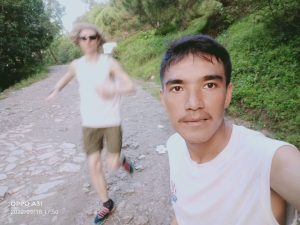
‘What kind are your shoes?’ And my shirt, my shorts, my watch, he asks. ‘Is it Suunto?’ And, ‘Can you bring shoes to my village?’ What about gels? The sun is dipping, and now I’m worried about obligations: what am I supposed to give and who am I supposed to give them to and is this the whole reason Gopal wanted to meet me…
‘I gave them to Pemba,’ I explain, another runner from a village adjacent to his. Pemba will use them, which he calls ‘power gels’, at the upcoming sixty-kilometre Sindhupalchowk International Trail Race. I wish I could bring gels for everyone, but anonymously.
The anxiety’s punctuated by a snake, a harmless slim colubrid, though still freaky. We jog down the trail, dusty and dry. It becomes a jeep road, rocky and wide.
‘Come to Ramechhap,’ he suggests. ‘After two weeks in my village, you’ll be a very strong runner.’
Okay. And what gifts should I bring there? What do I owe?
When we’re down from the hill the red sun is lowering, the sky is a warm blue. We pass paddy fields and Maoist party offices indicated by hammer and sickle signage; my chance to ask about politics. ‘Do you like the Maoists?’ I attempt.
‘No.’
Local people shout namaste and hello as we pass. A little boy tries to follow us for a few hundred metres.
‘They’re happy to see you,’ Gopal explains. ‘To see a foreigner.’
When I’m on the bus back to Gokarna the woman I’m sitting with tells me that her father is a British Gurkha. ‘I miss him,’ she says. She mentions that Queen Elizabeth II is dead, and I tell her that I’m a ganatantrabādi, a republican. ‘Oh… in the UK the king is in charge?’
That stumps me. I try to explain how it works in the UK, but I can’t, either because my Nepali doesn’t extend so far or I don’t really know. I hadn’t really thought about it, other than as a distant joke, my field notes show no
record of it. It’s completely dark now and when I get into my flat I’m hungrier than before I left and there’s been a power cut.
When I try to sleep, after the televisions have stopped, the strays’ barks bounce off the houses, ricocheting in the alleys, not reaching the river. In Siddhartha Tol seventeen commercial establishments rise up in my year and a quarter’s stay, and then there’s all the new residences. I wake up every day to the sound of drilling and hammering, migraine-making. If there’s another earthquake, there’ll be no place to run to. I think about Sundarijal, approaching the edge of awakeness. The outer world is green, an escape, beyond the valley.
Kathmandu’s environmental problems multiply in the rift in my head.
I once asked a waiter at a cafe I visited regularly, ‘What’s the Nepali word for dustbin?’
‘Municipality,’ he joked.
But everyone complains about the Wai Wai, Snickers, Lotte Choco Pie, Frooti strewing the world, twelve hundred tonnes of waste per day. Mars Inc. makes up the bulk of pollution, so popular are Snickers. Even the hills aren’t safe from the rubble of progress. Some of it gathers in square dirt pits which a volunteer or city workers might carry away or a hill dweller might burn. When the sacred Bagmati exhales it bulges polymers. But the mayor Balendra Shah talks tough:
‘When they try to give you a plastic bag in a shop, just say, “Balenle plastic pardaina bhaneko chha”’, a friend told me. ‘Because of Balen, we don’t like plastic.’
And the air. As of writing, Balen is PM. What will the PM do about PM2.5. What can I do? Ah, Kathmandu… Everyone tries to get here, then they try to get out. But while they’re trying they have to breathe.
Maybe the UFOs or the Chinese will save us…
I absorb the truth and my head creeps towards a different Kathmandu—solar city, something else.
Are you there? In the dark and the quieted televisions?
In the silence?
This whole conurb is thrumming with memories. Memories of villages…
Will Young is a writer from the UK. He is currently writing a book based on his doctoral dissertation on the trail running culture of Nepal, with the prospective title Where the Gods Dance.