
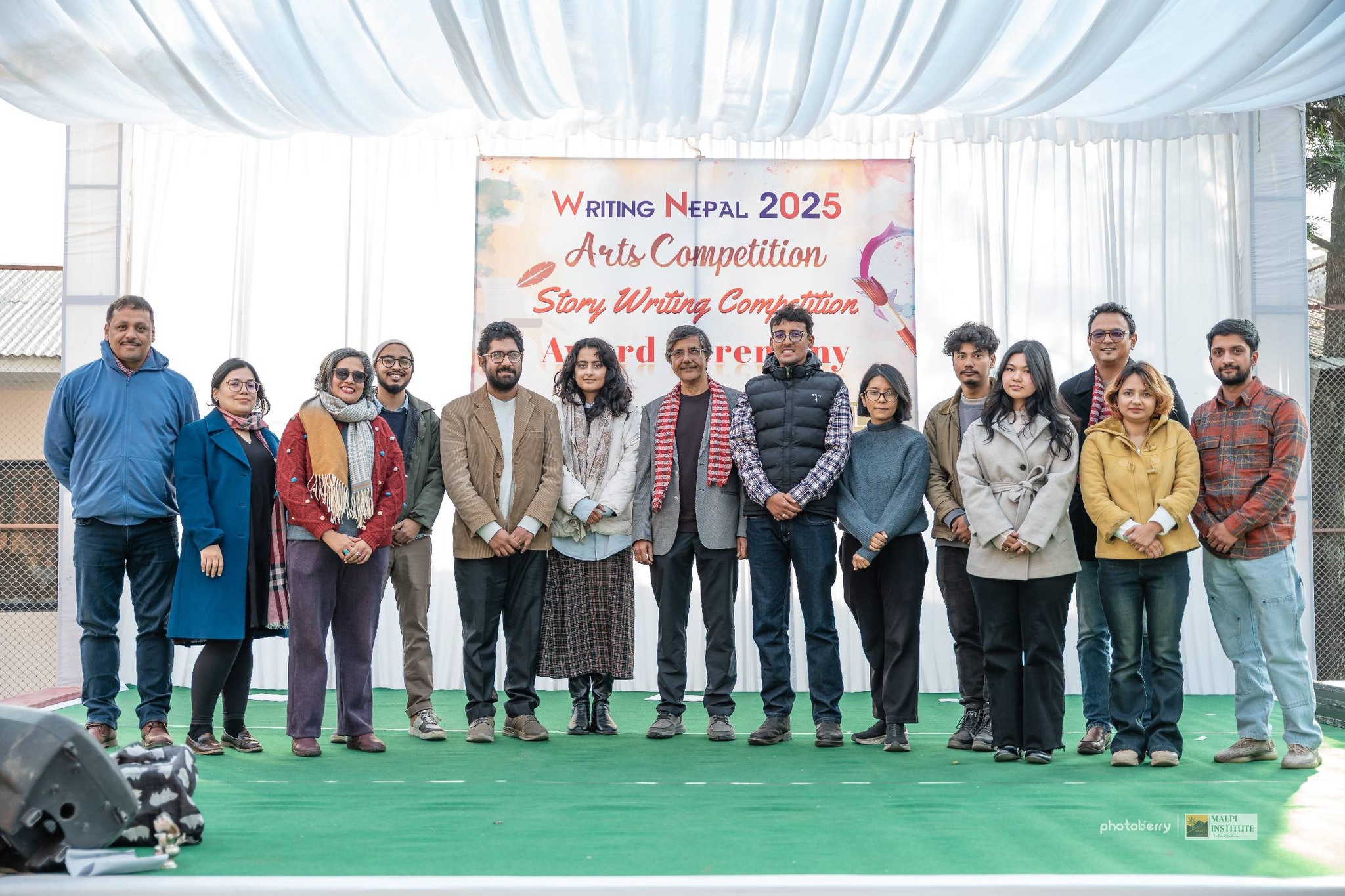
This is a story about stories. Some stories arrive quietly, some knock hard on the door. The seventh edition of Writing Nepal reminded us that stories, no matter how they come, always carry a sense of arrival. Writing Nepal has become more than just a contest; it has become home to hundreds of stories, lingering, waiting, searching for a space to be heard. Twelve years on from the first Writing Nepal, this edition witnessed an unprecedented response, with over 350 submissions.
Noting the maturity of craft and originality of the submissions, Samrat Upadhyay, the contest judge and the author of Arresting God in Kathmandu, stated, “Reading them, I felt like I was becoming immersed in the messy, often uneasy realities of being human.” His observation underscores the intricate relationship between literature and the human experience, and these stories reveal how literature gathers fragmented lives into a shared emotional collective.
The award ceremony, held on 26th December and hosted by Malpi Institute, Baluwatar, celebrated emerging writers and brought together writers, readers, editors, and literature enthusiasts. Before the crowd of keen young eyes and ears, judge Upadhyay invited the twelve shortlisted writers to read out excerpts from their stories. The readings, along with Upadhyay’s short introduction to each one, heightened the sense of excitement and audience members could be seen holding hands, eager to hear the announcement of the winners.
Geetanjali Hall by Urza Acharya (Taranga) won third prize. Upadhyay summed up the story: “Set in a gritty, run-down movie theatre, this story follows a tough ticket seller named Ninamma who finds a brief, tender connection with a younger coworker, only to be left alone in her bleak reality when the girl disappears. The story’s loveliness lies at the quiet ache at its centre, set in a dilapidated building where survival leaves little room for softness.”
In the Morning, the Cock Sometimes Crows by Sandesh Ghimire won second prize. Praising the story, Upadhyay said, “What struck me most was how painfully the story captures the fragility of masculinity under the pressure to provide, shaped by the emotional and physical toll of Nepali migrant labour in the Khadi countries. Subash’s reaction to catching his wife red-handed in her affair with their renter elicits a tangled surge of rage, shame, and even arousal, which feels brutally honest. In fact, the story is so honest that it’s deeply unsettling, perhaps even revolting, and I love stories that shock and enthral and leave me reeling.”
No Country for Neptes by Kundan Shrestha won first prize. According to Upadhyay, “The reason this story is the winner is that it skilfully captures the pain and the struggles of its two alternating characters, Bir Bahadur, a Gorkhali soldier and his wife Oni Sara, as they suffer the toils of war. Their two worlds rarely meet, yet the ache between them is constant. What I loved the most about this story is how its quiet, unhurried style mirrors their exhaustion. The writing moves between them with a gentle, observational rhythm, letting small images carry emotional weight without big drama, in a prose that’s textured and grounded.”
Our special thanks to Malpi Institute for hosting the Writing Nepal Award Ceremony, and for arranging such a warm stage and beautiful dance performances to begin the programme and set a merry mood. The ceremony and the venue allowed the emerging writers to come forth before the writing community, share their creations and inspire those present.
As always, we thank Samrat Upadhyay and Indiana University for supporting new writers and encouraging them to share their stories.
Congratulations to all the winners! We thank all the writers, all 351 of them, for participating in this literary event.
La.Lit will be publishing the winning stories and selected shortlisted stories online in 2026.


