Ninamma handed the movie ticket to the man in front of her. As he gave her the hundred-rupee note, his hand lingered on hers a moment too long. His thick, greasy fingers grazed the back of her hand, leaving behind a sticky residue.
The film Mero Jovan Timilai — My Youth is Yours — had been playing for over three weeks now, and this man had been coming twice a week to catch the evening show.
“So, when do you get off work?” he asked.
“Never,” she replied, her voice cold, flat.
Ninamma looked past him — at the peeling paint, the broken tiles on the floor, at anything that wasn’t him.
“Randi,” he hissed. Whore.
The word thrust itself through the air — heavy — like spit. She didn’t look at him, but she could feel his gaze burning her skin. As he disappeared into the hall, he left behind a pungent smell of diesel and sweat.
Ninamma was used to this. Geetanjali Hall was a place of decay, and she was one of its decaying parts.
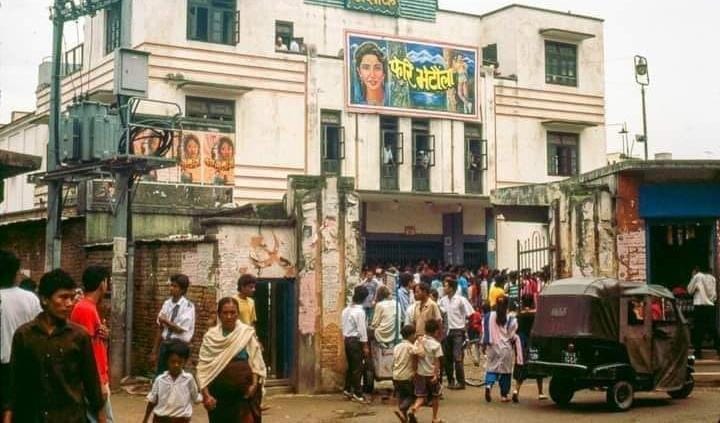
The movie theatre, nearly thirty years old, had once been built with promise — the dream of a cinephile who wanted to bring the likes of Rajesh Khanna and Amitabh Bachchan to his city. But since he couldn’t afford land in town, he built the hall on the outskirts, on land gifted by his father, beside a river that was once alive. It was located just beside the bridge, and from the road, only half of the building’s form was visible. A large hoarding board faced the street, the name of the hall written in bright colours. Much to the cinephile’s delight, the place came to be known as Geetanjali. The walls were a blend of faded pink and white — unusual hues for the city — and its tin roof was dotted with spinning aluminium exhaust fans that whirred tirelessly day and night.
At first, the cinephile’s enthusiasm seemed full of promise. The hall showed reruns of classic Bollywood films — Sholay, Mughal-E-Azam, Awaara — and later added Nepali favourites, starring Rajesh Hamal, Sri Krishna Shrestha, Dilip Rayamajhi, and others. But the grander halls inside the city were closer to those with money. Those around Geetanjali could only afford to faintly listen to the heroes from the outside. The temperamental, righteous heroes and their fair, forgiving heroines turned out to be too expensive to invite onto his screens.
Over the years, the settlement around the hall grew crowded and grim, the air thick with the stench of the river and diesel fumes from the nearby bus park. Once a landmark, its pink and white walls were now cloaked in stubborn shades of grey. Many of the exhaust fans on the roof had stopped spinning. It was now surrounded by humble teashops, suspicious rest houses, and dingy bhattis. The river — sluggish with the city’s filth — formed an invisible wall that kept those with fair noses and cleaner clothes away. The area was reclaimed by those who served those with fair noses and cleaner clothes.
As the years wore on and the metal rusted, plaster cracked, and seats tore, the hall, too, changed course — like the polluted river beside it — and began letting in something fouler.
Now, Geetanjali Hall played only the dirty and degrading — B-grade films made by loveless men, starring loveless women whose naked bodies were examined and dissected for the pleasure of other loveless men. Each night, the hall filled with lanky, worn-out men — labourers, drivers — who reeked of sweat and exhaustion. They came here to forget who they were, swallowing hastily the bitterness of the outside world and pouring it out as whistles, jeers, and groans in the dark.
They munched on matar-chana and cheered when the heroine was grabbed and groped. They found themselves in the angry, vengeful hero who beat up wealthy villains. If one looked closely, one could almost see their tired, melancholic souls leave their bodies, slip through the screen, and enter the hero’s chiselled, fashionable physique. That’s when they felt powerful. Wanted. Whole.
Ninamma knew better than to challenge these men. A smile could be mistaken for an invitation; a frown could invite greasier hands. She had cut her hair short — almost ugly — and wore the same oversized, full-sleeved shirt and jeans every day. A tight brassiere flattened her chest. No earrings, no makeup, no colour. The less visible she was, the safer she felt. They could smell womanhood like musk — like kasturi in a deer — and she had long learned to hide her scent.
Vijay, the hall’s manager, was a short, pot-bellied man. Whatever remained of his hair snaked around his scalp, leaving the top bare and bright with sweat. One afternoon, he walked toward the ticket counter with a young girl.
“This is Sapana,” he said. “She’ll be working with you.”
Sapana — dream — had olive skin and thick black hair that looked almost too heavy for her petite body. She wore a kurtha and jeans — the netted polyester fabric clung to her thin arms, and her wrists looked fragile enough to snap in two with just a little force. Her features were sharp — almond-shaped eyes, a softly curved nose, and full lips. Her long hair fell in loose curls, and her lips were pink with cheap lipstick.
Ninamma noticed she smiled too easily.
“Hello, didi,” Sapana said brightly.
At first, Ninamma didn’t know what to make of her. Sapana was polite, eager to please, even deferential — offering to sweep when the cleaner didn’t show up. But by the end of the week, she had begun chatting with the men who came to buy tickets, tilting her head, leaning in, giggling at their jokes. Some slipped her extra notes with their tickets. Others brought her packets of chips, chana, or a bottle of Coke.
Ninamma pretended not to see. She just knew Sapana was trouble. Nakkali. Coy.
Yet she found herself looking at her — noticing the small mole beside her lower lip, her gentle laugh, the way her hair rested so softly on her chest.
She felt almost protective of her. She wanted to shake her, tell her how men could smell weakness, smell womanhood — how they always wanted to buy what they believed they could own. But she also found herself watching her — the way Sapana tucked her hair behind her ear, how her voice changed when she spoke to customers and sometimes even Ninamma, soft and playful, as if she were trying on a new skin.
One afternoon, Sapana said, “Didi, will you take me out for lunch today?”
Ninamma hesitated. “I don’t have much money.”
“It’s fine,” Sapana said, slipping her arm through hers. “We’ll share.”
They ate at a small bhatti near the bus park — dal, rice, and a single plate of chicken curry. Sapana talked the whole time — about her village in Ramechhap, her father’s debts, a boy she used to like. When the bill came, she looked at Ninamma expectantly, eyes wide and unashamed. Ninamma paid.
After that, they grew closer in the strange way women sometimes do — not out of choice, but out of shared misfortune. They covered for each other when the manager asked for extra shifts. Ninamma watched as Sapana put on her pink lipstick, fixed her hair in the mirror, and gushed over new kurthas at a shop nearby. Ninamma often bought her tea and doughnuts from the stall outside.
“Didi, can I stay with you tonight?” Sapana asked one night as they were closing up. The men had all wearily returned to the real world. “Just for one night.”
Ninamma hesitated, then nodded.
Her flat was a single room on the ground floor of an old house run by a bitter landlord. It had green walls, a small bed, and a table with a gas stove in one corner. There was a small wooden window with iron grills – the wood defeated by a thick layer of enamel that had begun to chip away. There were no utensils except for a dented single cooker and a karai with a handle missing. She didn’t even have two glasses. It was late, so they had packed momo — seventy-five rupees a plate — from a nearby bhatti, bought a few cigarettes, and come home.
Sapana entered the room and plopped herself on the bed. She moved with a sense of familiarity, as if visiting an old friend. She noticed the kajal on the table.
“Abui, you wear kajal too? I’d have never thought!”
Ninamma blushed.
“I must see you put it on.”
“No, come, let’s eat. That’s silly.”
“Didi, please, let me put it on for you.”
She moved closer to her face, and Ninamma could feel her soft, warm breath against her skin. Sapana rested her palm on Ninamma’s cheek and slowly began to draw the black kohl around her eyes. She was slow — first tracing along her tear ducts, asking her to look up, then gently along her lashes. Everything felt still. With her eyes closed, Ninamma felt warm and safe — like she did when her mother had caressed her hair as a child.
“How beautiful you look!” Sapana said.
Ninamma had never thought of herself as beautiful. Her skin was coarse, her hands calloused and dry. Beautiful was a word from a fictitious realm, like in the cinema hall. And she had seen what happened to beautiful women.
“Didi, you should grow out your hair and wear kajal. You’d find a good man then.”
Ninamma opened her eyes. She suddenly became aware of her shabby room, the peeling walls, the small window with chipping enamel. Even the kajal seemed to weigh heavily on her lids.
“Bhayo. Dherai na bol. Come, let’s eat and sleep,” she said.
After dinner, the girls lay under one blanket. Sapana said softly, “Didi, sometimes I wish you were a man, then I’d have married you for sure. You’re always so nice to me.”
Ninamma said nothing. In the dark, they simply lay together. Sapana breathed softly as she fell asleep. That night, Ninamma dreamt of brushing Sapana’s hair.
The next morning, when Ninamma woke, Sapana had already left. As she opened the window, a cold and unfeeling breeze brushed against her skin.
When she managed to drag herself to work, she found Sapana at the counter, giggling with a young man buying his ticket. The man was teasing her, calling her a heroine, offering to buy her momo if she left with him. Ninamma felt something rise in her chest.
Later, when she joined her behind the counter, Ninamma said, “You shouldn’t talk to them like that.”
Sapana shrugged. “Come on. They’re just silly boys.”
“They’re not silly boys, Sapana,” Ninamma said sharply. “You keep doing this, people will think you’re a—”
“A what?” Sapana’s eyes hardened.
“A whore.” Randi. Ninamma spat. The word tasted bitter. Heavy. Like spit.
Sapana flinched, then straightened. “Well, that’s what they think already. You think your haircut keeps you safe? They still look at you the same way.”
The rest of the day drifted by like an old clock struggling to move its rusted hands. No words were exchanged. No tea or doughnuts were shared. As evening fell, Ninamma saw Sapana leave with the boy from earlier — laughing, her arm around his, her thick hair brushing softly on her chest.
Sapana didn’t show up the next day. Or the day after. The manager, his mouth swollen from the ghukta, muttered that she had probably run off. “Girls like that fly away like the wind,” he said. Ninamma tried calling her, but the number went unanswered.
That evening, the hall sank into its usual decay. She returned to counting the cash, meticulously separating hundreds, fifties, twenties, and tens. She wore the same oversized shirt, her hair tucked behind her ears in the same way. Around her, the walls peeled in stubborn patches, and the tiles remained cracked, just as they always had.
Mero Jovan Timilai had now been running for six weeks. The loveless men came once more to watch the loveless women flicker across the screen.
Outside, the river gurgled faintly, thick with rot.