

I
AN OPEN LETTER
Dear fellow countrymen,
Stillness is death. No matter how much you shout, scream, scatter, fight, hide or fly, you’ll end in this stillness if you do not find your voice. That no one can give you. It is an arrival. Hope we find each other in common land.
Much love,
K

II
He narrates his story. She, hers:
“Just what do you mean by ‘the people of this land are resilient?’ Do I understand by this that they accept whatever is thrown at them, never questioning?”
I was furious with her casual approach. We’re talking about a revolution here that’s been going on for the last 20 years and still, the apathy, the passivity, the complacence. This is not resilience. Turning a blind eye to that which does not affect you directly resolves nothing.
“But so much has changed. It’s slow. It’s happening,” she said. True. Not the whole truth. The degree of change, has that been questioned? Mindset and culture, has that been taken into consideration?
Prolonged passivity makes leeches of us all!


III
Piece by piece the world around him collapses, he knows this too well. But inertia and inaction have become habit. Each morning he wakes with a fight that doesn’t last an hour into the day. First the knees weaken, the heart sinks, the body relents and then the brain dies. No sooner does this happen than he subsides into the all too familiar trance of doing nothing. Sometimes the hands of a clock move faster than the limbs and days turn to weeks that turn to…self-loathing. He’s now resigned to the smallness of his room and yet those close have faith, they wait… hoping change will come, but he’s died too many deaths.
There is darkness in broad daylight that’s found rest under the skin of everyday life. Little does she feel this horror! Hers is an unshakeable faith – good shall prevail. And so she waits…like so many more. Their voices fade as the hot air rises. Ignorance accomplishes nothing. And here faith provides no relief, rather supplements the horror. Soon, very soon, she’ll become a ghost.
They wait… and wait… and wait…
This city will soon become a valley of ghosts.


IV
In God’s country He fails to be recognized because He is everywhere?
If God exists it would be necessary to destroy Him. Start all over if we had to.
We have a new national anthem. Does it mean something? Do WE have a national anthem?


V
Let all that is old burn
On that busy street, the taste of revolution poisons
The insides out, pricked by new hope.
An old gift in new cloth.
Let it rise from the ashes, if it rises not from the heart.
The road lies ahead. Soon, it will be far behind.
What make you of your time?
Of your hands? Of your mind?
Let it burn then, till nothing remains.
Shall nothing remain?
WE MUST NOT WAIT.
I found ‘Flames and Fables’ like heading into an excursion into the “contrasting spaces” within Kathmandu, not unlike the protagonist and his endearing gori girlfriend on their scooty. There is the space of Rabin’s room and the delightful voice of his weary mother. There is Maggie Gyllenhaal’s unwelcome presence in our couples’ sex life. Then, there is Lord Ganesh “blatantly eavesdropping on all conversations.” The details of this story, rendered in deft strokes, turn a claustrophobic city into one of excitement and spacious character.
– Samrat Upadhyay, judge
Flames and Fables
It was as if someone had shot a gun in the house, and all windows were thrown open to get the smell of sulfur out of the corners, Rabin thought as he opened his eyes and looked around the room, washed with the sunlight streaming in through the east and south windows. He hadn’t heard gunshots in a while, with the city returning to its usual routine after the recent wave of strikes and demonstrations.
He sat up on an upholstered bed, covered by a sheet with elaborate dragon prints, monsters swirling and slithering on the cheap Chinese fabric, swallowing their own feathery tails. Sitting on the edge of the bed with his feet firmly planted on the grey carpeted floor, he looked down. The sheet was blue in color, all twisted from agony and nightmares, still damp with perspiration that made his nightshirt stick.
“Rabin, Rabindra,” called a voice from outside the door. “Are you awake yet?” He didn’t answer. He disliked being interrupted in the mornings. His sense of coherence was still hanging on a nail in some forgotten empty room of his dreams, beyond reach.
“Do you want milky tea or lemony? Come on Rabin, answer me!” rose the voice.
“Ama, I am awake. I am awake,” he replied while staring at his ragged flat nails. He couldn’t stop chewing them. Scraps of his cuticles were peeled back to show the glistening pink of his flesh.
“I can come and cut the lemon. Just put some water on the stove,” he responded, looking in the direction of the door. He thought about the tangy juices from the fruit seeping into his cuticles, sending shocks of jittery pain up his spine. He stood up, his right hand trailed down and tugged at the elastic band of his briefs. He swung his upper body to the left and gave a sharp turn to his neck.
“Your editor called about half an hour ago. He wants you to call him back on his cell phone before you reach the office,” said Ma, pausing for his response.
“What did he want at this time of the day?” asked Rabin agitatedly, more to himself than his mother. He didn’t mean to wonder out aloud. It was as if she was standing there waiting at the door for this moment. Her lingering about had a deeper purpose and the minor lapse on his part fulfilled all her designs.
“How am I supposed to know that?” Ama erupted. She slapped the door with her open palm. It made a loud thud. He dreaded that dull thud. It meant something far worse than anger. It was the sound of hopelessness. It said that she was longer proud of him, as she had been when he was fourteen and bagged the first prize in the citywide essay competition.
“You are 26, Rabin! I don’t understand why I still have to take your calls and also answer difficult questions,” she cried.
“Ma, I will be late for work if we start this now,” he implored, looking out the open windows. Rabin had his mother’s whetstone eyes and the square of his chin was neatly framed by the black hair of his goatee. Evelyn liked his goatee.
In the heat of Saturday afternoons, when they both sprawled on the straw mattresses atop the balcony of her rented apartment, she would roll over on her stomach and turn towards him. Her hands would reach over and touch his cheeks. Her pale skin, covered from head to toe with sunscreen lotion and freckles, clashed against the deep brown of his body.
“And oh, she called,” Ma said. “Miss Eva-li-en wanted to chat with you at six thirty am.” Every word uttered was weighed down with solid, bitter resentment. “Gori, she is going to spoil my son rotten,” she said with a heavy sigh, which he could hear through the thick door that separated mother and son.
*
“Rabin, what does Gori mean?” Evelyn asked while running her hands through his dark hair, glistening under the Saturday sun.
He looked into her sea-green eyes. Her cheeks were burning red and the golden nose ring trembled under her even breathing. She smelled of sandalwood, it was the cologne he had given her the month before.
“Don’t be silly Eve, you know what Gori means,” he replied. He didn’t like these conversations. It had to do everything about their differences. She turned into something else in front of his eyes, whenever he paid closer attention to how her skin folded around her body. A porcelain doll with her toenails painted black and dark French bangs hanging over her eyes. But he wanted her to be more than that. He didn’t want her to disappear behind the faces of actresses he had gawked at for hours, in those weekend screenings of Hollywood flicks inside the cultural lobby of the American Council.
Once when he was inside her, Maggie Gyllenhaal popped into his head. He didn’t want it to be that way, it just happened. Maggie’s face just came up and he couldn’t help himself from liking it. For two weeks after that, he couldn’t look Eve in the eyes. Sometimes, the guilt was so repugnant he couldn’t even stand being in the same room with her.
“No, like I know what it means,” she said. “But I want to understand the connotations. Isn’t fair skin one of the thirty-two prized features in a Hindu woman?” she pursued the topic stubbornly.
“Well, my mother certainly doesn’t seem to agree with that,” he said, grinning towards her. “Or maybe she is just jealous of you.” He didn’t mean it and was actually surprised to have said it.
“No Rabin, this isn’t about jealousy,” she said in a serious tone, not responding to Rabin’s effort at making the conversation looser. “She is the damn harpooner and I am her white whale. She has made it her obsession to hunt me down and remove me from your life.” Eve punctuated herself by sitting upright; her hands now lay folded and tucked in the midst of her lap. It appeared as if she was meditating.
“Come on Eve, you don’t need to bring Herman Melville into this and make this conversation all allegorical,” he said, struggling to suppress the glee in his voice. Evelyn drew complex symbolic interpretations from almost everything that happened to her. “And are you honestly comparing yourself to a big albino whale?” He raised himself and gently grabbed both her upper arms from behind. There it was right beside his fingertips, brightly outlined in the clear noon light, in blue and black ink, the writhing body of Moby Dick.
“I mean, she worships Vishnu, the god of whalers.” Evelyn turned around to look at Rabindra’s face quizzically.
*
Evelyn Brough, native of Salem, Massachusetts, attended Boston College for four years and got her B.A in English. During her college years, she was obsessed with John Ashbery’s poems and still remained so. She made the decision overnight to drop her radio station job in Boston and work for an English newspaper halfway around the world.
Rick, who had been her junior year boyfriend, was sharing stories from his recent adventures on the slopes of the Himalayas at the Seven Philosophers in Boston. They were both leaning against a jukebox; Son of a Preacher Man was filling the room, mostly crowded with graduate students from the surrounding universities. After a while, the song stopped distracting Eve.
“Getting to Makalu base camp was a piece of cake,” Rick said loudly. “It was Kathmandu which was just awful to be stuck in,” he said, careful not to slur his words. “Fucking claustrophobic man,” he tried explaining. “Surrounded by these tall hills all the time, missed the salt water too much.”
That’s exactly what it was. It was the water that she had grown sick of. The harbor glaring at her every time she went on errands around the city, she needed to get away from all that. The sticky salt of sea on her skin and the fishy aftertaste hanging in her throat all needed to be washed away with hilly air and chilled juniper smoke. It didn’t take more than two weeks for her to hear back from Abhi Sharma, editor of The Himalayan Post. The daily had agreed to hire her as one of their desk editors.
*
Rabin pushed the door open and stepped out into the hallway. The narrow passage was dimly lit by yellow light from a twenty-watt bulb hanging naked from the ceiling. There was a calendar marked with the year 2056 plastered on the wall at the end of the corridor. Underneath it on a wooden stool was a maroon telephone set. Fifty six years ahead of its Gregorian counterpart, the Hindu calendar had laminated pictures of deities sprawled on each flap. For this month it was the elephant-headed Ganesh, with the unbelievable roundness of his gut and broad expanse of his ear flaps. He sat on a plush purple cushion, blatantly eavesdropping on all conversations.
“Hello, Abhi-ji?” Rabin spoke into the mouthpiece. “It’s Rabin. Was there something urgent that you wanted me to check on?” he asked.
“Rabin-ji, thanks for calling back,” Abhi spoke from other side. “I wouldn’t have disturbed you this early if it wasn’t an important assignment.”
“Of course, of course,” he replied, rolling his eyes. This was the third morning call he had received from Abhi this week.
“I know that the political beat isn’t your thing, but this is something interesting,” Abhi said and waited for Rabin’s response.
“Mhm?”
“A guy called me at home late last night. He said that he is a member of the politburo for the Maoist party,” Abhi took a long swig of what could have been either tea or his morning peg of Johnnie Walker. “He is in Kathmandu for couple of days. It is supposed to be an undercover visit. I want you to get an interview from him for Monday’s paper.”
“Sure. Where and at what time am I supposed to meet him?” Rabin asked, trying his best to cover the irritation in his voice.
“I told him I would send my reporters to Athchowk at eleven thirty. That’s about two hours from now,” he took another swill of his drink and smacked his lips. “This guy will be wearing a green flannel shirt. Okay?”
Rabin jotted down the details on the Moleskin that Eve had given him. The frayed skin of his fingers grazed lightly on the ruled pages as he scribbled down details in his curved writing.
“Got it, Abhi-ji,” said Rabin, getting ready to end the telephone conversation.
“By the way, why don’t you also ring up that American girl and take her with you! She needs to get out in the city and understand a few things about this damn revolution,” Abhi finished the sentence, didn’t wait for Rabin to respond, and hung up the phone.
*
Athchowk was a well-known place in the city where eight different roads converged. It belonged to the old part of Kathmandu, littered with narrow lanes and numerous courtyards. Houses built a few centuries ago still stood standing around the roundabout, while the families within them separated and scattered. Everything seemed to swell and breathe together towards the sky. At the center of the chowk stood a stone pillar on top of which there was a king’s statue, kneeling on his left knee with his hands joined in prayer. On his right shoulder perched a golden bird, ready for flight.
“Rabin, wasn’t there some story about that bird you told me?” Eve asked, turning towards him. She was wearing one of her best sun dresses, with a light yellow silk scarf neatly tied around her head. Large flower prints on the fabric made her even more noticeable amongst the crowds.
She and Rabin had just arrived at the chowk. After his conversation with Abhi, he had called up Eve to tell her about the assignment. She was glad that the editor had finally come around to throw something real her way. It was becoming tedious to be cooped up in the office all afternoon, correcting misplaced modifiers and educating Nepali reporters about gerunds.
She had been to Athchowk with Rabin once before. Their trip had been a part of a more usual routine which Eve and Rabin had established some weeks after meeting in the office. Usually when the newspaper was put to bed, Rabin rode his scooty over to Eve’s place. From there they would shoot off into the extending darkness of the evening. These excursions led them to contrasting spaces within the city, some of which even Rabin had never been to. One evening they had decided to ride through all the puzzling lanes which snaked in and around old sections of Kathmandu. They had been successfully lost for hours and didn’t even bother to ask for directions. The scooty ran out of gas right about when they reached Athchowk. It was close to midnight and there wasn’t much life out in the streets. Sleeping bodies of beggars draped under jute bags huddled together with stray dogs near the pillar.
This afternoon as they waited, however, they were looking at the pillar from further away, standing under temporary awnings made from bright blue plastic tarpaulins by the shopkeepers. Now, surrounding the base of the pillars sat several middle-aged women, the ends of their sarees covering their heads from the sun. In front of them were bamboo baskets full to their brims with bottle-green leaves of lettuce, cilantro and mustard greens. There were pyramids of clementines and oranges, and sticky pulp from gourds and melons coating the dusty ground. Then, there was the silent king, sitting there for centuries and worshipping his city, and the bird as his only testament for a glorious prophecy. Ominous clouds were hovering in the sky; the vendor women uncovered their heads and stared patiently skywards.
“They say that on the day this golden swallow takes off from the king’s shoulder,” Rabin paused, “this city’s people will be ready for self rule.”
“Much like a democracy,” Eve chimed in happily. “It’s wild that some fifteenth-century king of Nepal had already thought of a modern concept like self rule.”
“This country has always had its share of wise stories and storytellers,” Rabin spoke more to himself. “But none of that wisdom stays, except in fables and mute statues.”
Then they heard a commotion headed their way, within earshot. The vendor women hastily started to collect their goods and run into doorframes, which were gateways to labyrinths of alleys and escape routes. As they hoisted up the mats on which the vegetables had been piled, several of the melons and gourds rolled onto to the ground. Some of them spilled out of the bunched mats and smashed on the ground to split open.
Eve could see flickering flames dancing several feet away. Many of those walking about stopped and stood. Everyone’s eyes seemed to glaze over, not in fear but in a kind of unwavering expectation.
“Rabin, what on earth is going on?” Eve asked anxiously.
“Oh shit, it’s the mid-afternoon masaal julus,” he replied, his nervousness fixing him to the spot where he was standing.
“Wait, is this the infamous procession I have heard about from every reporter at the office?” she asked.
The first masaal julus had happened in the summer of 2055. It started as a group of ten youths, who wore black coveralls and blindfolded themselves. They each carried a burning torch in broad daylight and walked silently through Kathmandu’s streets holding hands. The number of procession goers had gone up. No one knew where this group congregated and to where it finally dispersed. The photo journalists had tried their best to predict the site of the following procession and had repeatedly failed. The black mass was ephemeral, as it never lasted more than ten minutes. This one heading towards Athchowk seemed substantial in size. There were about fifty men and women, their lips pursed together, leading one another silently through the streets. Motorbikes, cycles, auto rickshaws and taxis had all parked themselves, quietly giving way to the procession. The naked soles of their feet dragged over the dusty asphalt and made sounds like when the snow falls. The flames under the blazing sun and their grave faces could spook just about anyone who saw them.
Eve stood there overcome with fear, as the blindfolded procession marched past her. Their flames threw translucent shadows on the ground and the heat from them smacked every bystander on their faces. She turned towards Rabin and like hundreds of others who had lined up in the street to witness this ritual, he was also spellbound. She on the other hand was just plain scared.
Then the bell tower struck noon, and the quietly walking bodies started bolting in whatever alleyways they could find. The flames hurled past Eve and Rabin, within seconds there was not a single torch in sight. The tension in Athchowk expanded and then dissolved. The traffic resumed itself with fury and silent spectators returned to the pace which they had prior to the procession. It was at that moment when Rabin’s face relaxed, that Evelyn understood what Rick meant when he used the word “claustrophobic” to describe the city.
“Rabin, are you alright?” she asked, recovering from her own thoughts and paying attention to Rabin’s pale face.
“Wasn’t that something?”
“Yeah…”
“That was something…” he sighed and leaned against the closed metal shutter of the store in front of which they were standing.
These days, Kathmandu’s artistic calender is busy enough to offer choices. This hasn’t always been the case, but now that its started and we’ve packed ourselves thick, it will probably only get busier. There are some who would believe that quantity is an essential to the birth of quality. A facebook events skirmish will reveal that the city is clearly not lacking in quantity anymore.
On Friday evening, two exhibitions – Troubadours: Poetry on the Move and Explorations in the Photographic Medium v. 1.5 – opened at around the same time in Image Ark Gallery, Patan and Bikalpa Art Center, Jhamsikhel, respectively. This reviewer happened to stumble upon the opening of the former and run into the latter during the course of the weekend.
Image Ark Gallery is a rather small space and is run by a communication and design company. Baroque tackiness was apparent in the opening event. In themselves, the performances – poetry, dance, and music, were enjoyable, although not exhilarating. The Word Warriors had a rather stale set of poems for one who regularly follows their events while the bebop and musical remix retained a unique flavour. Some of the poetry that was read was plain bad, reading more like a quickly scribbled journal entry with nothing but the words carrying it. No metaphor, no rhyme scheme, no deep set idea – pure verbosity. Others, especially from the Nepali language poets, had a richness of flavour and depth that gave an indication of Nepal’s poetic tradition. The din of Patan in the background was both a distraction and a complement to the words. An interpretive dance based on Madhav Prasad Ghimire’s poem was perhaps the most surprising and heartfelt. But the mixing of the medium and the collage-like composition gave the whole event a lack of cohesion. The event often meandered so far from poetry and travel that the linkages became tenuous.
Fittingly, the illustrious Kiran Manandhar came up with a masterpiece in under 10 minutes as the show kicked off. His work was set up in the front room and it tantalized the viewer with invitations to experience the inner motions of regurgitation. The usage of impure colours dabbed around certain structures that invite interpretation along with a complete disinterest in how colours interact with each other are the apparent hallmarks of Manandhar’s work. As one can clearly see below, the basic idea behind the painting appears to be mountains and doves representing our dreams of peace and harmony with nature. A powerful and moving work, indeed. The reasons for such an expression of genius while poetry was being recited? The breakdown of all narrative into incoherence, perhaps. Another piece from a fragmented opening.
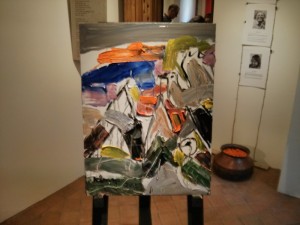
Kiran Manandhar’s painting at Image Ark
The artworks themselves were all displayed on the first floor. It takes one less than 30 seconds to circle in and out. The proximity of walls really hampers one’s ability to view the artworks, while the artworks themselves are nothing to write home about. The idea held some promise – the visualization of a/the kernel of a poetic piece. Unfortunately, the execution displayed a feeble, scared attempt at really delving into the poetry. Its worth questioning why art, that has a medium, means and message of its own, was needed for the poetry – these poetic pieces, in particular. The exhibition exhibits little thought toward this.
If poetry is the lead in this, as it would appear from the way the exhibition is titled, do the artworks reflect the poetry? The simple answer is that they do, at a basic level, but the longer one spends time with the poetry, the less representative the art becomes. They mimic the words but not the essence. Take the photo collage (shown below) done on Nayan P. Sinduliya’s poem, Basantapur, which uses the poet’s own photography in a haphazard collage along with a printed text of the poem. It resembles the work of a poet asked to do artwork rather than an artist trying to interpret the poem. Fragments of the poem get reflected in the composition, but the state of mind and the meaning the palace square takes on in the poem remains largely absent from the work itself. The painting for Gaurab Subba’s Rainbow City shows a mental laziness that comes out in the lack of precision of the brushstrokes and attention to detail in the colour composition. The attempt at using the colours of the rainbow comes across as dishonest. Further, the standardized architectural symbols of Nepal are juxtaposed with a concrete urban landscape that is clearly too organized to be anything but Kathmandu. One cannot but think that the metaphors and poetic license used in the poem would encourage more expression from an artist with a bit more passion.
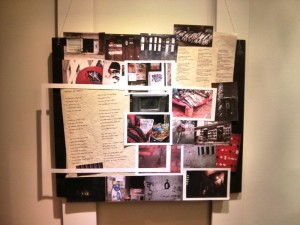
Collage based on Nayan P. Sindhuliya’s poem, Basantpur
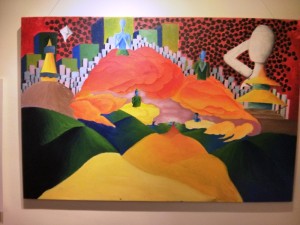
Painting based on Gaurab Subba’s poem, Rainbow City
The next day, this reviewer took a walk around Bikalpa Art Center where its latest exhibition was on display. The exhibition showcased the work of seven artists currently enrolled in the Kathmandu University Center for Art and Design. It was the product of a semester-long elective on photography taught in conjunction with photo.circle.
Mining the rich vein of personal experience and the use of visual material in its interpretation, the exhibition is perhaps one of the most engaging works of photography to come out of the art school. The aesthetics and style of presentation of the exhibition betrayed a heavy influence and conceptual work on the part of photo.circle, but also was successful is bringing out some of the potential of the students of the art school.
A video installation by Amulya Shrestha reminded one of Beckett’s Krapp’s Last Tape. Using photographs and the artist’s own memories, it captures his attempt at recollecting a past of which he hardly has any recollection. The rather eerie voiceover keeps the viewer engaged while the simple camera work, direct framing and light setup give it an air of nostalgia. An installation by Saran Tandukar of photographs pulled from facebook raised questions about the role of social media in the creation of memories. It also brought out the more sinister notion of the loss of privacy and the entry of the private into the public. Artists also furnished self-narratives and narratives of their homes. Such revelations of the private and the intimate come out the strongest in Sudeep Balla’s photo set and bottled collection.
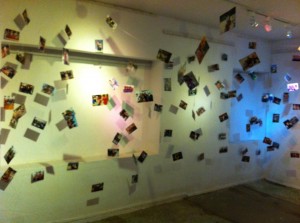
An Installation from Explorations in the Photographic Medium v.1.5
The most telling difference between the Image Ark and Bikapla exhibits was the artistic intent behind the production. Troubadours worked with poets, but seems to have neglected the artists who were meant to bring out the visual aspect of the poetry. Explorations on the other hand worked with artists and in doing so was much more invested in the final artistic product. This perhaps defines the disparity between the two exhibitions.
Disappointment is a part of the artistic process and it perhaps reveals what lies ahead more than success. In that, the visual prospects that rise out of Kathmandu’s dirt appears to have the promise of quality mixed in with quantity.
I am not easily given to liking second-person stories. Often I find the mode artificial and gimmicky. But Pep Talk had a no nonsense quality about it that immediately sucked me in. I liked the narrator, and there was clearly a story here: one of love and heartache, of sexual experimentation and discovery. The telling perfectly matched the tale. I appreciated the boldness, the inventiveness, the shattering of structures. More than anything, I admired the tightness of the story, how in six pages an entire history was told and dispensed with.
– Samrat Upadhyay, judge
Pep Talk
Make some coffee, Arunn. Although, what you really want is a cup of milk tea, with cardamom, with cloves. Grind the organic coffee beans she bought from Nuwakot. Let the black liquid drip through the cloth of the clay cone into the cup. This is the only way to drink coffee, really, she used to say with every cupful. Dump the second cup of coffee. Resist the urge to make things for two now. She never liked hers black anyway. You don’t have sugar, you don’t have milk, you’re not a morning person. The cordless phone is low on battery. She doesn’t live here anymore.
Forget the smell of her shampoo. The chemical sugar scent that lingered on her pillow, like streaks of wet hair that arranged themselves on the bathroom tiles post shower, when she forgot to pick them up. Forget how sometimes, when the faucets were dry, you two carried buckets of water into the bathroom. The first time you showered together, you thought it was an accident. She stepped out of her clothes to sit down on the low wooden stool. She loosened her hair and untangled her legs. You let out a soft eh, as though you remembered something you’d long forgot, and gathered your towel and slippers to leave. But she scooped a cupful of water and held it out to you. We’re made of the same things, she said, you should see the American women in the American locker rooms. You hung your towel up on the door, took the cup from her hands, and poured the water over her head. You lathered places she couldn’t reach as she listed secret sights from within an American locker room: a constellation of freckles threading the arms, shoulders and face, a passing brown lower back accented by an umlaut of dimples, faded pink nipples that look pasted or painted on, erratic black hair peeking from underarms, a warm bulge of belly shaded by a thin line of travelling hair, wrinkled thighs and necks creating folded patterns, an orange head of hair paired with orange wisps over delicate parts, and stubby dotted legs that slid on wet floors.
Remember the night she undressed you? Korean donors in suits had visited your work place, studied the profiles of students, pledged more money, and celebrated over chicken lollipops and large bowls of fruit punch. The insidious kick of the alcohol sent you stumbling home. She found you fiddling with the padlock on the chain gate. When she asked you if you were okay, you threw up. She dragged you up one flight of stairs and leaned you against the doorframe of the bathroom as she took your clothes off. In that drunken blur, you remember thinking how you had never been naked in front of another woman. When you changed your clothes around others, you did what every girl in your village was taught to do: turn around, put your hands in your blouse, sling a new shirt over your head, slip your hands through the sleeves, and peel the first shirt off your back. But for the first time with sore clarity, you knew what you wanted. You wanted her to look at your body. The way you looked at hers. How her legs strung by silver stretch-marks, widened and joined her hips, which rose and then dipped into her waist that circled up to touch her breasts as they fell away softly pulling down her birth-marked shoulders. But instead, she was fidgeting with the tap and calling you names: Donkey brains! Donkey brains! She drained out what felt like the largest cupful of brown water and rinsed you methodically. You were dried, tucked inside a thin dhaka shawl and left in front of the living room fan.
Don’t think about that morning after, when you walked into her bedroom to apologise for your drunkenness. She stirred and turned around to face you. As she lifted her blanket to let you into her bed, your I’m sorry dropped gently on her pillow somewhere. Half asleep, she shook her head, draped an arm around your neck pulling you into a hug, as you felt her nipples soften against yours. Shhh, let me sleep, she said with breath like the worn insides of an old plastic bottle. Winter had taught the two of you to huddle for warmth in the mornings but you had carried this ritual into the summer, and past the rains. Sometimes you slipped into her bed. Sometimes she floated into your room with her sun-dyed hair in a mess about her neck, her eyes barely open. You two laid in bed longer especially on weekends when you felt no guilt about the day passing outside the window: her cousin in the office downstairs screaming on the phone Forget Me Not Travels, Namaste!, the children playing marbles and fighting over discarded cycle tyres, the neighbour’s chickens clacking and dodging city wheels, the pressure cookers whistling an indication of midday meals. Then, you two went to Rupa didi’s store to buy a packet of milk, bread and vegetables for a late afternoon meal. She chopped and you cooked while tuning into English songs on the weekend FM stations.
Stop asking yourself how you got here. What if she hadn’t seen you, a sixteen-year-old then, standing in school uniform waiting for glasses of sweet yogurt with raisins and pistachio at the lassi place in Asan? What if she hadn’t been the only one to ask you how you liked the new school, the other students, Kathmandu, as though she read your homesickness in the sweaty lines of your palms? What if she hadn’t told you about the time she travelled with her father to your village? If she hadn’t asked after your Kalpana didi who sold the best churpis that hung hardened on thick strings yet melted milky in the mouth? What if, after that lassi day, you two hadn’t spent the rest of high school sitting in the back rows of classes giggling and tipping your chairs on two legs, your arms pushed against the walls, and your fingers locked? What if Sundays weren’t days when she invited you over to her house, and you two walked up to the rooftop with bags of oranges, laid on your bellies, and did your homework until your elbows turned ashy and worn from resting on the concrete? What if you hadn’t spent all your pocket money calling her every evening from the phone at the knick-knack pasal outside the hostel? Pressing your lips so close to the receiver, as though you weren’t going to see her jump right off that school bus at 7:15 the next morning. What if she hadn’t left for America? What if you hadn’t stayed in the city? What if you had kept in better touch? What if you hadn’t seen her five years after high school — Americanised in her short hair and loose clothing– at a fundraiser party in Thamel where you asked linen-clad tourists to sponsor an education? What if she hadn’t recognized you? Hadn’t asked you where you were living or told you about her father’s death, or about taking over Forget Me Not, or about the empty family-owned apartment above the office in Lazimpat? What if, when you agreed to move in with her, she hadn’t kissed your cheeks and nose and eyes so blindly and hugged you so tight you swore a part of her entered you? You felt like she never left in the first place.
Forget about the night you discovered that feeling lodged in your chest, in your breasts, that suddenly spread deep into your armpits. You felt its sharp yet vacuous presence grow as she told you about an American hiker, a man who had walked into Forget Me Not looking for an adventure. You initially dismissed it as nothing: another white man who wanted to learn Nepali for a minute, who had finally found his place in the world, and was now ready to open himself to a Nepali girl. But she wasn’t any Nepali girl. In just the year you had lived with her, you watched her revolutionize her father’s old travel agency by hiring only women staff and guides, and providing cheap eco-friendly trips. She had even appeared on the local women’s magazine cover as one of Nepal’s “youngest social entrepreneurs;” her interview was so full of English words, you had a hard time sounding them out in Nepali letters. The feeling in your chest and breast and armpits returned when you found out that her American hiker had done more than just inquire about a tour package. He had affected her in a strange way. One day, you found her stuffing her face with daal bhat and talking about foreign penises. Did you know that a non-Nepali penis doesn’t carry with it an extra cloak? The tip sticks out like a head. It wears a little cap. Like, like a mushroom. Her one flight-of-stairs long commute from the office below was now filled with laughter as she spoke into the mobile phone in her renewed American accent. You had never imagined she would find a home in a random stranger. A home built on just one tiny hair of a fact that they had both read an obscure book written by yet another foreigner, a book about solitude of one hundred years.
Erase the memory of how the American, slowly and quickly became a part of the clanking of kitchen utensils. His cologne mixed with the smell of your chickpea potato curry, a dish she loved because she claimed only Arunn could get the chickpeas to the right softness. She used to be your garlic chopper, your dish-wiper, your green bean snapper, your can opener. But in what seemed like seconds, yet weeks and months, he had taken over parts of your role. He insisted on doing the dishes as she wiped and he said cans didn’t need openers; they needed a real man’s muscles. She laughed at his cocky jokes, as you stirred the chickpea curry to puree.
Clean up. Do things. Stuff the clothes she left behind in plastic bags, suck them skinny, and give them away. The other things that remind you of her, such as her toothless comb, her yellow plastic gun earrings, the hardened lentil gravy stain on the stove, three precious baby photos, her bathroom slippers, her pink nail clipper, the wooden stool, the smell of coffee in the apartment; pack the packables, eat the eatables, throw the throwables, give the giveables, keep the unkeepables. Like that memory of lining up for a warm samosa and milk tea in December, keep that.
Don’t check the phone. She will call once she is completely settled in her new place. Somehow without anyone else’s permission, you had imagined a home for the two of you. You had imagined yourself as an old lady on Saturday afternoons, squatting and scrubbing her back in the sun, counting her raisin-like moles. You had imagined carrying hot water bags into bed to soothe your aching backs. You had imagined learning how to knit socks for her so that she wouldn’t slip around the house. But the American had other plans for her. You remember the moment she told you, teary eyed, about how exciting the journey had been. How ready she was to take the American seriously, their lives seriously. You remember asking her should I leave too? In that you meant, didn’t it make plain simple sense that you would go wherever she went, that remember, you two were stitched that way? But she heard something else. She told you to feel free to stay here, that the place was empty anyway. But you know there is no space in this apartment for loss.
Forgive her for her language, her gestures, her love. Don’t think back to her moving away party when she introduced you to the American’s friends as her girlfriend, in English, and it validated your feelings for once. She spoke with you and around you as she recounted stories of how we loved to sleep late into the day over weekends, and how we lived right next to the best samosa joint in town and how Arunn is the best masseuse and how her chicken curry, boneless, is simply to die for. You noticed the way she jumped back and forth from present to past tense. But remind yourself to forget of how she let your palm linger on the small of her back, and how when everyone had enough to drink, she pulled you to the sticky dance floor and swayed side to side guiding your arms to wrap around her waist, her right knee between your legs, her head on your chest, we better find each other again, she said.
Answer her call. She means it when she says she misses you. It was not her fault that she didn’t feel the pain in your chest, your breasts, your armpits. The pain you never revealed to her. When you visit her some day, you will see that she has set her new living room in the same way she set yours. Extra cushions on the ground next to the sofa, the tables tall enough to slip legs under, the wind chimes made out of bangles singing near the windows, the baby aloe vera plant above the TV. You will find that she has lined the kitchen cabinets with newspapers, folded to fit perfectly. She will make tea with not enough milk and too much sugar. But you will drink it and tell her about how one of the students from your village is thinking of taking up taekwondo so that he can impress the girl he sees every morning at his bus stop. She will tell you how she misses Rupa didi’s store. Then, concerned, she’ll ask you if you’ve found a new roommate. You’ll pretend to make a joke about how no one can ever replace her. She’ll laugh and slap your knee.
Sleep, Arunn. Because ever since she left, you’ve spent your nights looking for her. You remember waking up to find yourself in the living room, standing in front of an empty sofa, because somehow your muscles didn’t forget. They got used to you turning the TV off, nudging her awake, pulling her up by her arms onto her feet, walking her to bed as she muttered, you’re the best, Arunn, then tucking her in, closing her door shut and walking away. Into your own room.
Let the Rain Come Down is a moving story of a son’s complex relationship with his father after his mother disappears. The prose is lush and nuanced, the imagery fittingly dark and transcendent, and the story is filled with insights and surprises around corners. What finally clinched the deal for me was the ‘leap’ the story takes into the future at its very end: I was giddy with pleasure at being transported to another, higher reality.
– Samrat Upadhyay, judge
Let The Rain Come Down
Oh, what a small sky for so much rain.
– Colum McCann
Krishna wakes to the sound of the downpour rioting on the slate roof and the wind churning at the battered pine windows. A deep sleeper, he hasn’t woke up at night in a long time, but tonight his eyes open as though from a dog sleep. Even in the dark, despite the torrent and the din, he can tell the roof is leaking where the shingles have either cracked or shifted in the wake of the relentless heat and commotion, allowing the rainwater to slip between the tiles. He can easily fetch two china bowls from the adjoining kitchen and place them on the floor to catch the falling raindrops but won’t: last time it rained, his father had assured him he would replace the cracked tiles and make the roof watertight before the next drizzle, but even when the dark clouds had claimed the western sky and the quarry season was drawing to a close, he didn’t exhibit the slightest interest in securing the new tiles needed for the repair. Does he even remember the promise he made to Krishna as he struggles to sleep the whole night because of the staccato sound of the drops hitting the ceramic? By morning when he wakes to boil water in a tea kettle on the wood stove, the rain will have dug deep into the mud floor and almost seeped into the pine joists underneath, and only then will he know he has to keep his word. Had Krishna’s mother been around, she would have never let the rain drip into the house – not a drop.
Only when he pulls the homemade quilt over his cold collar bones and prepares to go back to sleep does he realize it’s not the pelting or the wind that woke him – it’s Bhishma, their dog, barking menacingly outside. Through the gaps between the howl and batter, he can hear his father coughing “Huche! Huche!” downstairs, a phrase he has come to depend on to impel Bhishma to chase away the monkeys feasting on the cornfield days before the harvest and the boys surreptitiously reaching for the pomegranates in the orchard with their tapering fingers.
Bhishma was his mother’s gift to him for coming third in the seventh grade three years ago. She handed him a veiled wicker basket she herself had woven. When he removed the cotton cloth, it revealed a curled black Labrador pup, asleep, vulnerable.
“Name him.”
“Me?”
“Well, he is yours now.”
A month ago Krishna had read the abbreviated Mahabharata in his Social Studies class and in a throng of the demigods in the sweeping epic, Bhishma’s vow of life-long celibacy so that his father could remarry had stood out to him. It was not his “terrible vow” that impressed Krishna, however – it was his ultimate sacrifice for his father’s rather narcissistic happiness.
“Bhishma. That’s a lovely name!”
But when the pup whined incessantly, wasting away what energy he had been born with, Krishna regretted picking a name the lab looked unlikely to ever live up to. The mythical prince’s courage to make a promise that would cost him his throne and eventually his life was perhaps too much for anyone to live up to, let alone a suckling pup. For the first two months, all Bhishma did was whimper and he never left the basket, hardly lapping up the corn soup or the buffalo milk.
Then one morning Krishna woke to find the bowl licked clean. At first he wondered if his father, finally giving up, had thrown away the food, but when he said no, Krishna was delirious. He cooked another meal for Bhishma right away, and within minutes of placing it by the basket, it was gone. In two months, Bhishma was porpoising around the yard, climbing onto his shins, and barking at him affectionately, his tail wagging all the while. And in three years, he had tripled his size and his whine had grown into a deep growl which scared the visitors and sent a dozen monkeys scurrying across the suspension bridge.
Propping his back against the pillow, Krishna gropes for the safety match on the makeshift headboard and strikes a stick, but the striking surface is damp and the brown cap crumbles before the head can catch the spark. He blows his warm breath onto the strip and with the fourth stick barely succeeds. Cupping the flame with his hand, he guides the teardrop flame to find the kerosene lamp and places the half-burned match on the wick until the lamp sputters to life. The burning light reveals a brass pitcher filled with stale water and his parents’ grainy black-and-white photograph in an askew frame on either side of a Radha-Krishna bronze statue. He lifts the picture and wipes the glass with the edge of the sheet even though no dust has settled on it. This picture was taken a few months after he was conceived, his mother had told him, and although the photograph doesn’t betray the slightest swell in her belly, he can see his life already pulsing through her pupils and fingertips, every part of her body conspiring to push nutrients into his tentative bones. Next to her is his father staring into the shutter too hard, and even though their elbows touch, the partition between them is unmistakable.
A week after receiving his mother’s gift, Krishna woke to find his mother wasn’t home. He trotted around the orchard hoping to find her pruning the dead twigs, but she was nowhere to be found. Back at home, he found his father slinging all clothes from the closet. The mattress had been upturned, quilt sprawled on the floor. All her saris, pacchauras, and jewelry were gone, too – except for her mangalsutra. He almost asked his father what was going on, but the way his mother had taken everything but her wedding necklace told him everything there was to know. Bhishma was, in retrospect, his mother’s parting gift. Had he known it then, he would never have accepted, but now the pup was the last tangible memory of his mother.
Carrying the lamp on his left hand, Krishna goes around the silo looming in the middle of the room, careful not to knock over the butter churner against the wall, and exits into the kitchen. Down the ladder, he descends a rung at a time. By the opposite wall of the main door at the foot of the ladder, when he reaches the back door to his father’s bedroom, once their vibrant clothing store, he raises his hand instinctively but finds the door open. Lifting the lamp high forward, he can barely make out his father’s silhouette wavering near the closed door that opens to the front yard. His father’s right foot stamping on the hardwood floor and clapping of hands send a tremble toward him. Outside Bhishma continues to bark with the undiminished vigour and conviction.
Once it was clear his mother was not coming back, on several occasions he overheard the relatives and some of the villagers urging his father to remarry.
“Life is hard and long, chhora.”
“Look at your boy. Ram! Ram! Who’ll look after him?”
His father would nod and manage a saturnine smile, but as soon as they left he would go back to plucking the weeds or watering the roots in the orchard and pretend not to notice the women’s blatant invitations to flirt.
His father continues to cough and clap, but what is he goading Bhishma for? At this time of the season the cornfield is only a shallow sea of saplings, and the monkeys know this as well as any farmer. Certainly no boys would brave the frigid dark for a bite of a raw pomegranate. He walks toward his father but stops a metre short from him. His father looks at him and then looks away.
“Go back to sleep.”
The lamp reveals the profile of a face that has long succumbed to the grotesque twists of fate. As his father brings his hands together, the pallid fingers appear magnified. It’s the same calloused hands that he feared the most when he and his mother returned after errands to collect debt from those who had not paid their dues by the deadline. His father was reluctant to sell cloth on credit, but in this part of the country no credit meant no business at all, especially when you faced stiff competition from the Newar shopkeeper by the suspension bridge who somehow managed to sell everything cheaper than they ever could. At least the villagers claimed so. But once the customers exploited his father’s good faith to its limit, they would avoid his shop altogether, and his mother would have to go knock on their doors.
Krishna loved accompanying his mother on those trips, but it was not as much the affected hospitality of the villagers or his mother’s company as it was the revelation of the disparity between him and rest of the village children that enthralled him in taking these long walks. He loved how clean and well-dressed he appeared in front of the children in tattered clothes tending to chickens and goats and the way they gawked at him made him feel like royalty. But when the sinking sun painted the skyline crimson and his mother showed no signs of returning home, Krishna would get worried. “Last time,” she would say, but soon he learned that there would always be another last time. Unable to sleep in the houses with strange odours and singed ceilings, he missed the scent of pomegranate blossoms wafting into his window and felt sorry for his father for having to struggle with coaxing the kindling and stoking the fire.
Back at home, his father would be waiting for them at the threshold.
“How many times have I told you to not spend the night in someone’s house?”
“You think it’s easy to pry money out of those clenched fists? Why don’t you give it a try sometime?”
Unable to conjure up an argument or tame his temper, his father would then rely on his quick hands to get his point across, almost throwing his mother off-balance.
“Never take chhora with you again.”
Since those years his father’s hands might have become bony, but they still inflict the same terror on him.
Krishna rests the lamp on a shelf at a safe distance from his father. He hears Bhishma growl. Suddenly he realizes Bhishma has no cover from the rain – his kennel was never meant for monsoons. He reaches for the bolt of the front door, but his father grips his hands.
“Tiger. There’s a tiger outside.”
It takes him some time to register the information. In the past few months, a tiger had been tormenting a neighbouring village: first the Gurungs’ goat went missing, then two lambs from the Thapas at the tail of the village, so they had formed an armed vigil group. Those who kept dogs clasped a hunting ring with sharp needles sticking out around their dogs’ necks, hoping that would at least lengthen the tiger’s assault and the growls would wake the house owners, if not the vigil group. There was no dearth of those, however, who doubted the efficacy of the iron ring and opined that its heavy weight would only put the dogs at a disadvantage.
Krishna envisions a tiger on the front yard, strolling toward the pen by the buffalo shed where the goats must be bleating next to the frightened chicken coop. The only thing that stands between the tiger’s canines and the goats’ fragile necks is Bhishma, but now even Bhishma’s growl is starting to lose some intensity.
Bhishma recycles his barks and growls. The tiger makes no sound.
“We must do something.”
“Yeah, sure.”
“Scream out the window for help.”
“It’s raining. Huche! Huche! ”
“The Vigil Group might hear us.”
“In this wind?”
“We can’t let Bhishma die.”
“Huche! Huche! Go. Go.”
“You’re going to get him killed.”
“He has the iron ring.”
But the spiked ring is not going to help Bhishma topple the wild beast at least twice his size, just as his father’s pantomime is not going to scare away the famished intruder that has already smelled its dinner. There’s a hunting rifle that belonged to his grandfather somewhere in the house, but even his grandfather never went out with it. Most likely it is rusted and empty, and even if it’s loaded, it would take a miracle for it to fire. He frantically goes through the shelves looking for something, and when he comes across a cotton rag, he stops – next to the rag on the shelf is Bhishma’s ring. He fingers the pointed arrows and in doing so pricks his pinkie.
“The iron ring!”
His father doesn’t look at him.
How could he? Dear God! How could anyone!
Now Bhishma’s growls grow fiercer and shriller – and then that terrible cacophony of the scuffle takes over everything – even the rain. Bhishma issues a long interrupted cry of bark-growl-whimper. Krishna can hear the bodies wrestling, a body being picked up and tossed onto the floor, claws tearing into the flesh. Piercing cries of agony escape Bhishma’s mouth. Oh God! No, no. Not Bhishma. Not like this.
Out the back door, underneath the ladder, he finds a desiccated branch from the firewood pile. After wrapping the rag around the branch and knotting its ends, he pours kerosene onto the wrapped end from the lamp and ignites it with the hissing flame. Carrying the torch aloft, he climbs the ladder, several rungs at a time. When he opens the window, he hears goats bleat and jump. The breaking of the bamboo rods of the pen reaches his ears too late. By the time he opens the other window which overlooks the shed, a goat squirms and suddenly grows silent.
“Tiger! Tiger! Guhar! Guhar!”
But even he can’t hear his scream over the relentless pour. Beside the orchard, on the rippling field, the stripes of an animal sparkle in the cameo of the lightning. The downpour has abated to a drizzle and the wind has quieted down. He comes back to the window that overlooks the orchard and waves the torch. The yard is sodden and empty, the only sign of the tiger’s visit is Bhishma’s low squirming coming from the shed.
When he tries to unbolt the main door, his father holds the latch.
“Not yet.”
“Let go of me!”
Krishna tries to wriggle his wrist free but can’t. Next thing he knows he has swung the torch at his father, the flame almost catching his hair, which sends him collapsing onto the pile of firewood. Outside in the shed, Bhishma is a lump of nauseating flesh and broken bones, black blood trickling from the edges. Seeing him, Bhishma tries to lift his head but can only manage the slightest stir. He reaches for Bhishma’s blood-smudged head and combs his hair. Bhishma looks at Krishna with his liquid eyes, wags his tail once, and then grows still.
The drizzle grows back to the downpour and the wind begins to shake the pomegranate trees.
“You let Bhishma die! You killed him.”
“We have to go inside.”
“Liar. Coward.”
“Enough now.”
“That’s why she left you for that man.”
His father raises his calloused hand but doesn’t bring it down on his cheek. For the first time, Krishna feels neither fear nor the anger to retaliate. Instead he feels sick to his bones. Within days of his mother’s disappearance, the news of her elopement with one of the debtors had reached every household. He looks straight at his father, and seeing his father’s bloodshot eyes and palsied lashes feels sorry for what he has said. But before he can say anything, his father disappears into the house and emerges with the hunting rifle slung on his shoulder and boots laced to the shins. A few steps down the flagstone path, he stops but doesn’t look back.
“If she really loved you, she would have never left.”
Krishna notices something cracked and liquid in his father’s voice tonight. As the footfalls start to fade, a wave of premonition and regret washes over him. When he turns around, his father is gone and all that remains is the impenetrable darkness.
Twenty years from now Krishna’s wife, while picking the ripe pomegranates, will suddenly drop to the ground and never wake, leaving behind a three-year-old son. Then he will see his second wife, after having her own son and daughter, treat his eldest like an outcaste, and will realize that his father didn’t remarry not because he didn’t find women nor because he caressed the false hope of his mother’s return, but because he knew too much about stepmothers. Only then will he understand the sacrifice his father made for him and realize how he had mistaken his father’s inability to express his feelings for his stoicism, and this moment will come to haunt him again and again as his son grows more gaunt and alienated with every passing day. This moment steeped in rain and darkness when his father gradually walks away from him toward the cornfield, fully knowing a man will be no match for a tiger, gun or no gun, when he could have run after him and said, “Papa, please. You are all I have now.” For the rest of his life on rainy nights, he’ll wake in the dark hours beside his mouth-breathing wife, Bhishma’s whimpers and his father’s “Huche! Huche!” ringing in his ears, and then unable to go back to sleep, he’ll go upstairs and place his ear on his son’s bedroom door hoping to catch the cadence of a stunted heart – but what he’ll hear is something unintelligible like his father’s hoarse coughs, the feelings all knotted and garbled at the throat, snarled clouds beyond the saving of even the rain.
The award ceremony for Writing Nepal took place in the cosy premises of Educational Book House yesterday. Our judge, writer Samrat Upadhyay, was rendered speechless. (Well, almost, courtesy a bad case of laryngitis. But he managed to gruff his way through.) Both he and the editor of La.Lit, Rabi Thapa, expressed a kind of surprised delight at the calibre of stories received, and the difficulty in choosing winners. But here they are, finally:
1st prize (Rs 10,000): Let the Rain Come Down, by Samyak Shertok
2nd prize (Rs 5000): Pep Talk, by Muna Gurung
3rd prize (Rs 2500): Flames and Fables, by Prabhat Gautam
Honourable mentions:
Between Queens and the City, by Niranjan Kunwar
Chamomile, by Byanjana Thapa
The Presence of God, by Pranaya Rana
Dolls in a Row, by Sarahana Shrestha
Congratulations to all of you, and thanks again to all of those who submitted their stories. We’ll be publishing the shortlisted stories in the days and weeks to come, so watch this space.
It is growing increasingly irreverent and tiresome to hear Gautam Buddha and Mount Everest being used as reasons for Nepali pride. Both are geographical happenstances regarding which the Nepali nation made no conscious choice. When statements extolling Buddha and Mount Everest are made by a person as eminent as the Vice Chancellor (VC) of Kathmandu University, it reflects our national surprise of being Nepali. And it becomes a hopeless, thoughtless, ethnically tinged zeitgeist-mongering moment when the VC adds the Terai to the above two. He gleefully shared his happiness in having the Terai as a part of Nepal. The existence and apparent preeminence of such a rationale for patriotism is perhaps why Nepal needs federalism.
The event at which the VC shared his rather antiquated ideas was at an exhibition, aptly named, A Federal Life. It was jointly organized by the Kathmandu University Center for Art and Design (read: KuArt, did all the work) and the United Nations Development Programme (read: UNDP, spared some change). Given the VC’s speech, one wondered what these aspiring art students would produce. To be fair on the VC, he did claim to be a noob when it comes to politics, and for the longest time thought it didn’t really matter. I wondered if the curator was making an installation out of the opening ceremony itself.
In Nepal, reality is generally more fantastical than fiction and if art is a reflection of society, do we end up with fantastic art? Unfortunately, not always. The exhibition, featuring 22 young to very young artists, has a number of interesting and engaging pieces. As a collage of how youth understand Nepal’s current political impasse, it is interesting. As individual works of aesthetic choice and political commentary, most feel about as good as owning a Chinese replica of an iPhone. You know what it is, but you also know what it isn’t. Some pieces are thoughtful, others have a strong sense of their visual presence, while others are good at appropriating proven methods of conceptual/stylistic mimicry. Few have the ability to blend these elements into a cohesive whole.
The exhibition’s flyer states:
The objective of A Federal Life is to increase knowledge among youth on Nepal’s contemporary constitutional issues as well as to establish clarity and initiate dialogue among the citizens on the role of federalism within their national context. The programme’s design focuses on civic education in a way that supports active engagement and discussion on the concept of federalism and its governance implications for life in Nepal.
In the next section, in what can be safely assumed to be a part of the method of civic education chosen, it states:
The first phase, implemented on May 11th and 12th, was a workshop designed to educate local artists on the concept of federalism and the debate on federalism in Nepal, so that they could, thereafter, create contemporary artwork which expresses their perspective on the topic.
Two things should be obvious from the above statements. One, the exhibition is a conceptually charged agenda (irrespective of the debate on whether federalism is good/bad) driven by a development agency whose primary mission is to help Nepal meet its Millennium Development Goals. The second point that is implicit is that since “federalism” is the thing that one needs “clarity” and “debate” on and is what was intrinsically a part of the civic education (again, irrespective of whether federalism is good/bad), “federalism” becomes a form of/means to “development”. While this reviewer is not making a claim for or against federalism, this review is certainly raising a semantic question on association and meaning creation. It is also raising a question about whether the conceptual agenda behind the exhibition qualifies the art produced as propaganda.
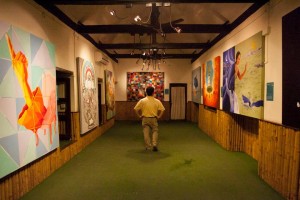
A Federal Life: Exhibition
Without a doubt, the objective of the programme is to influence a particular segment of Nepali society. It is hardly surprising then to see that some of the paintings replicate Panchayat-era nationalistic imagery. The reappearance of such imagery might partly be because a national aesthetic to re-tool the nation’s visual imagery has largely been absent for the past few decades. However, the methodology of the workshop suggested that a good deal of lecturing and spoon feeding was used. This is evident in most of the paintings. Its clear that a lot of knowledge was shared, but little attempt was made to challenge the artists themselves to think and articulate. It left them ambivalent as to federalism itself, with few artists in the exhibit directly tackling the question of federalism or taking a stance on it. Instead, the general sentiment tended towards disengagement. Passing on the buck is probably not the most desirable outcome.
More starkly obvious (as if the VC’s speech wasn’t enough) was how dislocated most of the artists are from national politics. It is apparent that most cared little or knew barely enough. A number of the works come with artist statements that either state their lack of knowledge, express their indifference or avoid direct engagement with the issue of federalism. There is no work that is directly opposed to federalism, while a significant proportion suggests that federalism is the way to go. The primary reason cited is the resultant decentralization, equality and resource redistribution – all textbook statements that barely peer through the colours. The ideas are being used as placeholders, regurgitated spiels bereft of significance within the artwork.
It is questionable whether any debate centred on these works can be initiated precisely because of the weakness highlighted above. It could be considered a means to generate curiosity on what federalism actually means. Better late than never, one may suppose. In so failing to actually engage with federalism, the artworks fail to be the works of propaganda the programme had initially conceptualized. However, the semantic association of the organizers rings true even if the debate stutters. So overall, the programme perhaps could have done better in achieving its objectives, but can claim a modicum of success in meeting its set goals. But that is development for you.
There are signs of promise in most of the work, and an aesthetic sensibility in the artists’ awareness of colour comes through. The works are, overall, visually pleasing. However, if the artists aren’t able to internalize the sensibilities in themselves or in the world around them, their work will always be fancy-looking fakes.
Details on the exhibition available here:
A few days ago, Samrat Upadhyay sent us his shortlist for La.Lit’s first short story competition, Writing Nepal. We couldn’t keep it to ourselves for very long. So here we go, in no particular order except the alphabetical, the 7 shortlisted entries out of the 100+ we were flooded with:
Byanjana Thapa – Chamomile
Muna Gurung – Pep Talk
Niranjan Kunwar – Between Queens and the City
Prabhat Gautam – Flames and Fables
Pranaya Rana – The Presence of God
Samyak – Let The Rain Come Down
Sarahana Shrestha – Dolls in a Row
Congratulations to the shortlisters! We’ll be contacting you individually. And thanks to all the rest of you who took the trouble to submit – we were overwhelmed by your creativity and passion.
We hope to see many of you at our event on the 21st of June, when the winners will be announced by Samrat Upadhyay. Details will follow shortly.
La.Lit
There hadn’t yet been a work in Nepali cinema that addressed the gamut of human involvement, the inter-personal mess, that was the political or the revolutionary. Tulsi Ghimire’s Balidan, and other films like Aago and Janayuddha are a few examples of what existed. The latter was produced by the Maoist party machine, and is an atrocious piece of badly written, badly acted propaganda. We should all watch it at least once. Balidan, on the other hand, was a tearjerker perfectly poised between the fall of Panchayat and the start of the Maoist revolution. Political films, however, have been numerous, and trite: hagiographies or xenophobic documents that can be dismissed as blights on cinema generally.
Then, along came Uma. It had a lot of expectations attached to it – the actors are among the best of their generations, and the director Tsering Rhitar Sherpa is a pioneer among his peers, for the breadth of his vision and for his courage to make fiction-films like Mukundo and Karma. Yet, strangely, in the theaters where Nischal Basnet’s Loot had done such phenomenal business that people expected it to breathe new life into a dying industry, Uma failed to earn at the box office, in spite of the flood of critical acclaim it gathered. Over at www.setopati.com, Director Deepak Rauniyar explains why Nepali films fail to do well, and in the process, has generated a debate.
Director (and writer) Tsering Rhitar Sherpa, writer (and assistant director) Tsering Choden, and writer (and actor-in-cameo) Kumar Bhattarai – and you can see, in this web of relationships, the very intimate space from where this film arises – have made a brother-sister-mother melodrama that is neither revolutionary, nor political, but quite a bit of both. That leads the film down a labyrinth of confounding choices, confused morality.
Uma can be called a Buddhist meditation, or mediation. It is the aesthetic middle-path:
– between extremes of ideology and emotion;
– between a cinematic sensibility geared towards the public and one that hews closer to the personal vision of the writer/director;
– and, between a grand ambition (to wrest away from politicians or their cronies the articulation of what the conflict meant, how it was manifest in the lives of the ordinary – be they a thug born-again as a rebel, or a girl who keeps remembering, to her annoyance and inconvenience, that she’d been forced to become a guerrilla fighter, to squeeze the trigger and hit targets without questioning why, or a young child witness to the execution of her father), and a humble submission (before the whims of the ‘film-going public,’ who, through their mysterious box-office ballots, as the arm of the invisible hand, direct the director in turn to cook with specific ingredients and spice with particular spices). All three are in reality manifestations of the same compulsion.
But, as can be said cynically of the middle path, it is the path of the middle-class, the group that lacks the courage to stand up against the oppressors, and also lacks the empathy required to fight for the oppressed. In trying to supply a moral prescription for how its middle-class audience should consider the conflict, Uma fails to placate either side, reactionary or revolutionary.
Let’s take two instances from the film: one for the brother (played admirably by Saugat Malla), and another for the sister (played equally admirably by Reecha Sharma). The policeman brother’s existential quandary: traditional duty. The guerilla sister’s: revolutionary duty. Both race towards the fatal conclusion of the film. But both of their actions ring hollow, given the specific rigidity of their moral cages. The middle-class morality or duty fails the policeman brother when his rebel sister visits on the eve of his wedding; the sense of revolutionary duty fails the rebel sister when she realizes the target of her assassination-mission is accompanied by the universal token of innocence – a girl child. In either case is an appeal to what passes for universal humanity, but is in reality in conflict with both reactionary and revolutionary logic. If the brother had arrested the sister, the fatal conclusion would have been avoided; if the sister had steadied her hand and found her target, the fatal conclusion may have been avoided. But that would fail a superseding logic at work: the need for melodrama, as fuel for cinematic immersion.
There is no difference between the policeman brother eating what his superior’s wife has cooked, and his rebel sister tending to the tea-burned hand of a too-young revolutionary. Both gestures are superfluous and icky-sentimental, without any light towards illuminating something new in the characters, which would have brought into better relief the thread of cause-and-effect that runs through the film. And that is a lamentable loss.
Anybody in the audience will be confused by the elation and deflation that she will experience as she sits through Uma – after a brilliant point on how, if the arts were dedicated to bringing about change, the violence of an armed struggle would be utterly unnecessary, comes a twee and sentimental setting-up of a minor character whose later death will set a protagonist down an inevitable path. Remove that sentimentality, and let the protagonists still make the choice to fling themselves into the face of the inevitable: then their humanity and Fate’s Strong Hand would seem more plausible plot devices.
But the frustration with Uma also comes from the moments of elation it gives: Tsering Rhitar Sherpa’s sensibility and his considered worldview is present throughout. The lightness of his touch is delightful – two little children dance to an Ambar Gurung song as segue into a more traditional hero-heroni dance. A propaganda revolutionary song-dance-flag routine seems so real that it at once registers itself to be the flawed kitsch that it really is. Nischal Shrestha says, “I don’t believe in castes, Anu! I’ll tear that thought out of the society! No, I’ll tear it out of my father’s mind!” and reminds us that we are watching a film, in a theater, and we’re happy for it. When Tulasi Ghimire explains how the movie business works, Uma puts aside the pretense of the heavy melodrama we came to watch, and pulls us into the film.
A more serious turn – Tsering Ritar Sherpa’s movie makes us deeply uncomfortable, with commentaries coming at the least expected places. Two policemen dig a grave in the deep dark of a rainy night. As they bail the grave with their shovels, they discuss a pyramid scheme, a Ponzi scheme: agents of the oppressive feudal and capitalist state-machine enthusiastically discuss the possibility of undeserved fortunes. But, as the post-conflict years have shown, the Maoist leadership had been selling the same Ponzi scheme to their cadres: Loss and gain have been very unevenly stacked since, don’t you think, Comrade?
Another – take account of the characters whose fates are left unresolved. If there is a conscientious, earnest guerilla who escapes into the night, there is another rebel, a potential rapist, a known murderer before joining the Party, who is also out there somewhere, now intractably ensconced in power. If there are hardy, long-time comrades at a meeting saying Lal Salaam to Prachanda – this name, ridiculously, silenced by our cowardly Censor Board – there are also very young children, forced into the fold. If there are people who came into the revolution through personal circumstances or ideology, there are others who confess to have been shanghaied into it.
This isn’t equivocation – this is equal-accusation. This was certainly the problem that disquieted Comrade Lal Dhwoj, who chose to stick to a safe reaction: that humanitarian sentiments have been portrayed well in the movie. If he’d agree with the director’s vision, he’d have to concede that the protagonists acted from a personal consciousness more often than they did from class consciousness – and that’d undo the Comrade’s revolution. On either side of the conflict, Uma doesn’t show the leaders of the classes in conflict – neither the feudal or monarchical oppressors (safe in their Kathmandu mansions), nor the revolutionary ideologues (safely ensconced in Indian hospitality). What are left on the board are the pawns, taking one step forward at a time, until the fatal diagonal move into certain ruin. Uma does that – it forces the audience to question their moral and political expectation from the film.
And that ability makes Uma a very important work of Nepali cinema, perhaps the most important Nepali film to have been released in the past twelve months. But it has become a frustrating and uneven work that it is now because it tries to please the theater-going audience, and in the process sacrifices pace, ambition and focus. Is that extra tinge of melodrama, that muting of a more ambitious idea, that choice of sex or violence just to take the audience’s mind off more pressing, more troubling questions, borne out of the audience’s insistence upon sex, violence, melodrama, and watering-down of difficult issues? If the director believes he has to make a movie that everybody will like, in order to attract enough revenue at the box-office to make future projects feasible, what does this say about the audience? Are we, as film watchers, getting what we deserve? Then, why do we grumble?
I hope there comes a day when a director of such talent and skill and passion for thoughtful storytelling as Tsering Rhitar Sherpa doesn’t have to add or subtract from exactly the film he wants to make, just in order to attract people to the cinema. I hope the audience of Nepali films will grow the courage necessary to demand better cinema by becoming better participants in the creative dialogue.


