

The sudden drop in water pressure and the croaking shower awakened me to the muddy reality swirling around my feet. I stepped aside for a moment, but the water stayed murky, slimy. So I killed the shower and moved to the washbasin, but the faucet gushed forth something equally fetid. The signs pointed to a major breakdown at the city waterworks. Cursing under my breath, I hurriedly scrubbed myself with a towel and brushed my limp, sticky hair the best I could. I even spit into my handkerchief and tried rubbing off the more visible stains, but dark, oily streaks still tainted my face and body.
Skipping this last day of orientation was out of the question, because the Chairman of the Department, Dr. Wallace, was to decide today on my induction into The Jesters’ Club, a decision that would determine my career as a jokester. It could propel me into the ranks of stand-up comics and celluloid funnymen, or consign me to the fate of coloured wigs, billowy pants and oversized shoes. ”Check with me on Friday about that, young man,” he had said with an enigmatic smile, when I had sought his signature for approval. “But do attend the Club orientation lectures in the meantime,” he had added after a thoughtful pause.
The weeklong wait had puzzled me, because all my incoming colleagues had already been granted membership. Perhaps Dr. Wallace wanted to observe me up close, I reasoned, and once he witnessed my dedication, my excitement and humour, his doubts would certainly vanish. I had thus been on my best behaviour all week and hoped to impress him by attending the orientation despite my condition. Besides, in my clean jeans and pressed white shirt, I felt my crazed appearance could pass for an attempt at slapstick. So I strapped on my backpack, took a deep breath and plunged into the humid late-summer day.
Unlike other mornings, the campus swarmed with green-faced students, all walking backwards. Yet another piece of fraternity-sorority silliness, I thought, waving back at those who pointed at me. I dashed up the steps of the imposing Jay Cole Hall and stopped outside the classroom to catch my breath, my body bathed in sweat. Patting my stiffening hair, I glanced at the clock in the hallway before gently turning the doorknob and tiptoeing to the rear of the room. The stupefied class glared at me with green fluorescent faces. I shook my head, but everyone remained unmistakably green.
Dr. Wallace squinted through his black-framed glasses in annoyance. “Are you sure you’re in the right place?” he asked, wiping a palm on his crumpled khakis and straightening the collar of his blue short-sleeved shirt.
I didn’t mean to stand around like a lost fool, but all the seats were occupied, and the incandescent greenery held me speechless.
“Well, do we understand English?” he asked with a straight face.
“Yes, yes, I – don’t you remember me, sir?” I replied, grinning. Everybody kept glowering at me.
“Pardon me?” he said.
“Yes, I am indeed part of this group,” I replied, but he shook his head in exaggerated incomprehension.
“We only speak English here,” he remarked with a smirk.
“Of course, sir, that goes without saying,” I said.
He cocked his head and surveyed me. Then in one graceful burst of energy, he raised his right hand and jumped into the air. As soon as he landed, everyone broke into song: “My house is my house/ and your house is my house/ the more we live together/ the stranger you’ll be…” Dr. Wallace guided the voices with sweeps of his hands and rhythmic flicks of the wrists, his eyes sometimes closing in apparent ecstasy. I listened for a minute and clapped heartily, but everybody sneered at me. They sang passionately and eventually stopped in perfect timing with the professor’s final, emphatic nod, his fingers curling into fists.
He beamed at everyone, pushed up his glasses, and proceeded calmly with the lecture.
“There are cultures with more concepts of time than our English tenses,” he lectured, scratching his thin upper lip and staring at me: “That’s why non-native speakers are usually bedevilled by our simple notions of time.”
Sure, I was slightly late, but not because I had misunderstood the tenses, I wanted to assure him. And what was with all this melodrama, I wondered, shifting from one foot to another, could this be one of the masterful practical jokes the department was renowned for?
“You could get a chair from another room, you know,” Dr. Wallace suggested after awhile, and I hurried out to comply, unwittingly slamming the door behind me.
The hallway flowed with green students walking backwards, and I followed suit, bumping into five people in my search for a chair. Unfortunately, the other classrooms were either occupied or locked, and it didn’t seem like a good idea to return empty-handed. I decided instead to grab some breakfast, and later straighten things out with the professor and inquire into his decision.
*
I back-hiked towards the main thoroughfare under a dark, threatening sky. Along the way, I began enjoying myself, having learnt to use the corners of my eyes and a different set of muscles. The motion tired me a little, but sharpened my senses in unexpected ways. Tickled by my newfound skill, I back-strutted down Hamm Street with a grin on my face. Clusters of haggard green youngsters – in punk, Rasta, hip-hop, and anarchist outfits – stared in puzzled reticence as I passed by, carrying my condition like a unique fashion statement.
I wolfed down some scrambled eggs, bacon and hash browns at The Squealing Hogs Restaurant, and tried to overlook the rude stares and bad service. But the heavy, palpable silence soon drove me out the door. As if on cue, lighting flashed across the sky, groundshaking thunder ensued, and the rains lashed down in a fury. I raced backwards towards the University, slipping at times in the downpour, all the way to the looming Jay Cole Hall. Leaving a trail of water in front me, I bumbled up the stairs and stopped outside Dr. Wallace’s half-open door.
He sat at his table, buried under stacks of papers-books-files, using both hands simultaneously to mark separate sets of paper. He worked with tense diligence, his thin, plucked eyebrows twitching incessantly, and I felt guilty knocking. Even after glancing up and chin-directing me to a padded chair across from him, Dr. Wallace continued scribbling away with balanced determination. But the paper piles appeared not to diminish. Perhaps he should grow an extra pair of hands, I had just joked to myself, when, lo and behold, he lifted his right foot above the table, bent his head a little, and puffed at a cigarette stuck between his toes. I was dumbstruck by his lithe athleticism, his flouting of the no-smoking policy, not to mention his dark, overgrown toenails.
“Yes, can I help you?” he finally asked impatiently, his bespectacled eyes turning gray and blue intermittently.
“Well, sir,” I began, hypnotized by the verdant radiance of his skin and those flashing eyes: “About this morning…”
“You acted unlike a graduate student, were late for class, rudely slammed the door, and skipped the lecture,” he completed for me, raising his foot to take another drag.
“You understand my English!” I said.
“I do now,” he replied, blowing an immense cloud of smoke that briefly obscured his emerald face: “You do surprisingly well for a foreign –, I mean, you know.”
“Thank you,” I said grudgingly. “By the way, I was quite impressed with your jesting this morning, sir, pretending not to recognize or understand me and…”
“Jesting, huh?!” he chuckled: “But then, it is understandable that you would perceive it that way.”
“But, sir, the song… green faces … people walking backwards …!”
“See, you definitely need to work on your diction and syntax as well,” he said triumphantly, pushing up his glasses: “Language, after all, is everything in a comedian’s profession.”
Then to my surprise, he kindly extended a packet of Lucky Strikes towards me. I accepted one out of courtesy, fighting a growing itch across my chest. He placed a lighter in front of me and sat back to caress his graying hair. Feigning nonchalance, I casually pulled off my slushy right sneaker, peeled off my smelly white sock, and inserted the cigarette between my toes. Then hunching forward a little, I lifted the foot with my shaky left hand to light the cigarette. This painful, strenuous effort rekindled my admiration for the professor’s graceful agility. The first puff made me cough myself hoarse, but as soon as I regained my breath, I started to apologize for being seven minutes late and…
“Late is late, young man,” he cut in sternly, fumes leaking out of his eyes.
I exhaled a thick stream of smoke in response, the cigarette-foot crossed over my left knee for easy access. A trickle of water traced a shiver down my neck, and my wet clothes grew heavier by the minute. “As for my appearance, sir…”
“Yes, have you checked the mirror today?” Dr. Wallace interjected, smoke curling up from his beaked nose.
“Yes, I have, and…”
“And you still chose to attend class in this state?”
“But, sir,” I said, wondering if he’d ever let me complete my thoughts: “I can explain everything.”
“Excuses, excuses,” he grumbled, his gray eyes flashing with indignation: “Late for class, unwashed face, strange hairdo, rude behaviour, and, of course, absolutely no greenery on your skin. All in one morning, too! Now tell me what you would think of such a student?” He asked the question with such sincere exasperation, with such pathos, that I almost spoke against myself.
“The thing is, it keeps getting worse,” he continued: “Now even your clothes are soaked, and you’ll probably miss classes because of a cold or something.”
I was about to protest his assumption, when a vicious fit of sneezing wracked my body, and I had to blow my nose into my handkerchief and flick away water droplets from my face. I began shivering as well.
“What on earth’s going on with you, young man?” he asked, raising his foot for a puff: “Is this some cultural thing? I mean, I just don’t get it.”
Your role as a music conductor and your turning green, are those cultural, too, I wanted to counter. But pressing my itchy back against the chair, I said, “I have learned much this week, sir, and I assure you that you won’t have to worry about me in the future.”
He nodded approvingly. “All right, good,” he said, deftly stretching his foot to drop the cigarette into an ashtray on the table: “I’m pleased you’ve finally begun to see things clearly. Once you get the full picture, everything should work out just fine. Good luck now.” Then being the busy man that he was, he abruptly returned to work, seemingly unaware of the central purpose of my visit.
“Thank you, sir,” I replied, sneezing and blowing into my handkerchief again. I dipped my cigarette into the puddle on the floor and flicked it into the trashcan with my fingers. “Before I forget,” I said, pulling out the form from my damp backpack: “I just wanted your signature on this, sir.”
He scowled and stood up and sat down at least ten times before deciding to remain seated.
“You said to come by today,” I reminded him: “Besides, everyone in class is already a member of The Jesters’ Club.”
“Which doesn’t necessarily mean anything, of course, yours being a singular case,” he said, fumbling with the cigarettes and lighting one between his fingers. Then with smoke seeping out of his beaked nose, big ears, and thin lips, he whispered: “You first need to fulfill all the requirements.”
“But I have, sir.”
“Well, what about the test in spoken English then, the Let’s Speak English Test?” he asked, his fine eyebrows twitching uncontrollably.
“Excuse me?” I exclaimed, wiping water droplets from my face: “I thought Graduate School, based on my records and their interview with me, recommended a departmental waiver to you.” “More importantly,” I continued, “You’ve conversed with me and heard…”
“Son, if it were solely up to me, I’d accept you into the Club like that,” he cut in, snapping his left fingers: “But in all sincerity, I am unable to grant you a waiver; you must take the exam. My hands are tied on this one.”
“Well, why wasn’t I…I mean, that would be fine, sir, except the test was conducted last Wednesday!” I said: “And the next one isn’t until December!”
He raised his right palm, with the cigarette pointing down, and shrugged.
I tried to catch his eye to make sure he wasn’t playing an epic practical joke, as master jokesters are wont to do, but he resolutely avoided my gaze – remaining as green as ever – and nervously tapped his cigarette on the ashtray. I fidgeted in my clinging wet clothes and fought against a sneeze that fizzled out. My entire body throbbed with itchiness.
“Well if you don’t mind…,” he mumbled.
A tangle of questions surged up, only to stick in my throat, and I scratched my neck and forearm with abandon. But that further inflamed my condition.
“No need to take all this too seriously, young man,” Dr. Wallace advised, looking past me: “After all, let’s not forget that we are a department of clowns.”
“Mampakha-beshyaka-khwasah,” I cursed swiftly, as I stooped to tie my shoelace with trembling hands.
“Whawuzzat?” he asked, his blue eyes flashing suspiciously.
“Oh, I said ‘Many thanks for helping me understand, sir.’”
This story was first published on suskera.org, a US-based literary webzine that featured contributions from Nepali writers. Suskera is now in partnership with La.Lit to republish articles from its archives.
It’s accepted that zombie flicks are less about lumbering, undead flesh-eaters than the emergent sociopathy of the humans trying to stay in one piece. The Central Zoo at Jawalakhel offers similar revelations, anticipated by a mural that exhorts visitors to consider the view from the other side of the bars.
All things considered, most visitors to Nepal’s only menagerie were as well behaved as the inhabitants; they limited themselves to communicating with their co-species through an assortment of febrile hoots and whistles. ‘Ey, they’ve already become lāto,’ remarked a young man, disappointed that the massive Himalayan Griffons hunched over on 12-foot poles failed to respond to his signals. Few animals in captivity suffer such a diminishing of horizons as do these raptors, whose counterparts in the mountain wilds are accustomed to soaring over scores of miles in a single day. Who wouldn’t become lāto, presented with the pointless gesticulations of hundreds of humans day in, day out?

It has become commonplace to characterise zoos as depressing places. They usually are, but this doesn’t justify avoiding them altogether. The animals may be circumscribed, but this is almost always out of necessity. The experience of encountering nature outside of nature commingles joy and sadness. A large male naur nods off under a gazebo in the summer heat, the antithesis of the springing grace with which it traverses rocky crags at 10,000 feet. The rhinoceros, larger than the life seen from a safe distance in the Chitwan savannah, is magnificent at his water trough, and triggers a flurry of camera phones. He then resorts to the repetitive movements typical of bored captives, and I am tempted to unhook the unsecured lock of his enclosure. Half a dozen jackals stream about their cages unceasingly in an unnerving display of kinetic energy while a clouded leopard slumbers nearby. But I note that the pens are being expanded. And as I stand before the leopard enclosure, wondering if the cub that was captured at my parent’s house in 2009 is among the felines here, one interrupts its pacing to bound off a platform and hurl its body straight at the wire netting between us in a single flowing movement that showers flecks of mud over me. It’s an indication of how mentally and physically separated I am from nature that I barely flinch at this display of fury that, in the wild, would mean the end of me.
I know my fauna, so it’s easy for me to laugh at my fellows when they wonder if a large crane standing stock-still by the side of a pond is dead or alive. A boy asks his father if the clutch of guinea pigs frolicking about are rabbit young? ‘They’re piglets’, he replies, unhesitatingly. ‘Won’t the elephant do anything?’ a woman exclaims, spotting a ride in progress, another tries to feed a giant tortoise a feather, and a herd of screaming kids rush by the animals, banging on a mādal.
Still, whoever takes the time out to watch beings of different orders will learn something, even if it’s just the fact that one can never claim to have seen everything. And the Central Zoo is by no means the worst example of ex-situ conservation around. The famed Bronx Zoo is spread over 107 hectares of naturalistic habitats and houses 4000 animals of 650 species, and my visit there was a revelation. I recall observing a pair of tapirs plodding along a muddy bank in a misty, humid enclosure. Can they tell the difference?, I asked myself. On the other hand, the empty languor of the lynxes hemmed in between the screeching primates and birds in the tiny circular cage of the Zoo de l’Orangerie in Strasbourg, France, left me uneasy. Between these extremes the modest enclosures of the 6-hectare Jawalakhel Zoo, ringing a large pond, houses over 700 animals across more than 100 species, and reportedly receives over 1 million visitors a year. Come to think of it, that’s twice as many foreigners as come to see Nepalis each year.
Nepalikukur may be apprehended here.
Do geckos know no vertigo
that they cling to the ceiling
to grope, entwine, mate violently,
unafraid of the waiting fall?
In this very room, years ago
buried within my lover’s mound,
I, thirstily drinking her up,
declared my love, undying love –
until she screamed, said – Stop! She
took my face in her hands, kissed the
wet lips, pushed me back, said – Relax!
She took me in a breath, loved me,
kissed my chest, marked me with sharp
nails, drew the grave where we’d bury
our secret. Then we went strolling
at midnight. Pokhara asleep
already, full-moon on Fewa,
Machhapuchre, lonely as ever,
watching me and my steadfast love
steal kisses outside shuttered shops.
But, no more is there her sly sigh
when welcoming to the pillow
her damp hair, or her neck to kiss,
or my hand on her arching hips.
Above me, unperturbed by the
ceiling fan, two slow, fat geckos
twitter their twined tails, cluck and clack
shudder briefly, as if they will,
without the glue of quick courting,
fall from the ceiling, fall from the
glue that equates them to dumb us –
who thought love would last forever.
In a recent article reviewing the Kalajatra exhibition at the Patan Museum, the artist Birendra Pratap Singh is quoted as saying,”Creating nude body of a woman is my way of satirising the current society which has become commercialised through advertising and is heading towards degradation.” But tudal, the wooden beams that support the eaves of pagoda temples around Nepal, have long been ornamented with nude deities and copulating figures. It is hardly a surprise that the female body is objectified in advertisements. When La.Lit’s Dionysian visited the exhibition, Singh’s art, in pen and ink, revealed a mature and delicate hand. But lines can captivate you for only so long before thoughts and questions begin to creep in. Where the satire resides in Singh’s art is a mystery; he risks mere replication.
The Kalajatra is Kathmandu’s biggest art event since the Kathmandu International Art Festival (KIAF), and it is being organized by Kathmandu Contemporary Art Center (KCAC). The generous contribution of its corporate sponsor was evident everywhere, not least in the gaudy purple LED spotlights that illuminated the entrance to the gallery. No one seems to have deemed the royal purple a satirical work in itself. Moving up and above the purple haze, the Dionysian was pleasantly surprised by the variety and quality of the works from the 30-odd artists on display, but perhaps the exhibition could have benefited from a more discriminating curatorial eye? The artworks are tightly packed into the space and offer little breathing room for the rather diverse array of styles, techniques and subjects. This may or may not have something to do with the exhibition’s stated cultural platform – Gai Jatra.
The exhibition organizers present Gai Jatra through three distinct ideas – as tradition, religion and satirical performance. All three ideas, as such, are uncontested. Recent history also provides ample evidence to suggest that the four days of the Jatra are free from censorship. Because of this cultural context, the exhibitors explicitly state that the Kalajatra is about defending the freedom of expression:
KCAC seeks to address conservative attitudes and censorship through performances and programs held at various cultural heritage sites of Kathmandu, symbolically presenting the message of ‘freedom of expression’ against the cultural backdrop of Gaijatra. In essence branding the festival as a platform for unbridled expression.
This stance is articulated in reference to the death threats received by Manish Harijan and the subsequent censorship imposed by representatives of the government during his 2012 solo exhibition, The Rise of the Collateral, in Siddhartha Art Gallery. It should be noted that the gallery agreed to the censorship in lieu of the death threat, accusing the government of collusion with those threatening violence. The gallery subsequently declared that “the state has back tracked on it’s commitment to protect a citizen (manish) – thus, the contract with the state remains in a state of abrogation as far as the gallery is concerned.”
Harijan has been an artist-in-residence at KCAC and, in his challenge, provides strong enough impetus for solidarity on the issue of freedom of speech. But the Dionysian couldn’t help but wonder if picking Gai Jatra as the battleground isn’t tantamount to admitting defeat. The organizers, it seems, have implicitly acknowledged that the other 361 days of the year are too risky, and that the legal and constitutional provisions that guarantee freedom of expression can only be fought for indirectly. Worse, this stance suggests that we are still in the dark ages of the autocratic Panchayat system.
Another facet of Gai Jatra that appears to have completely slipped through is its Kathmandu Valley-centered Newar roots. A conquered but culturally rich people, the Newars have dominated notions of Nepali culture and identity. Gai Jatra was never really a festival celebrated outside the Valley (a few Newar settlements aside). Yet it was a national holiday until recently. For a while, the media made it a special occasion, but it is in decline, its legacy consumed by the populist politics around it rather than by its communal nature.
La.Lit’s LatoKosero, writing on the Pride Parade that happens during Gai Jatra, suggested that it offered renewal to an otherwise dying tradition. There may be a case for the flamboyance and social/personal engagement necessary for the greater acceptance of the LGBT community, but using Gai Jatra as a platform for more general freedom of expression is problematic. In a fragmented democracy like Nepal, every day is a battlefield for the freedom of expression, not just days of exception.
The popular history of Gai Jatra makes it evident that this freedom of expression was granted to citizens; it is not something the citizens themselves possessed. The space allowed for satire during Gai Jatra has historically been a display of the strength of authority. None of the democratic urges in Nepal came out of Gai Jatra. Instead, it was the other way around – the democratic urges made the festival relevant before 1990, under the prevailing circumstances of authoritarianism.
Perhaps more significantly, in focusing on the political, the organizers have been completely swayed by the ceremony that surrounds it. Gai Jatra is existential at its core: it looks directly at death and laughs. It hides, within ritual, a deep-seated fear of the unknown, yet mocks the absurdity of existence. Some of the best works on display at the Kalajatra exhibition take their cue from within this brooding depth. For instance, Narayan Prasad Bhoju’s Banda presents the starkest contrast to the ritual around Gai Jatra and brings the viewer closest to its fears. The dull palate of colours provide a stark contrast to the more colourful ambience that surrounds the festival. In this particular case, the work benefits from its proximity to Shankar Son Shrestha’s Connection from Religious to Spiritual World. Shrestha’s painting doesn’t attempt much but its juxtaposition of a flimsy paper cow mask against the backdrop of the cosmos suggests an instinctive understanding of Gai Jatra.
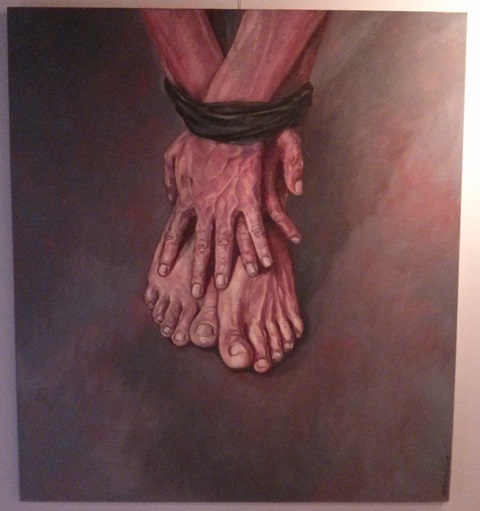
Banda by Narayan Prasad Bohaju
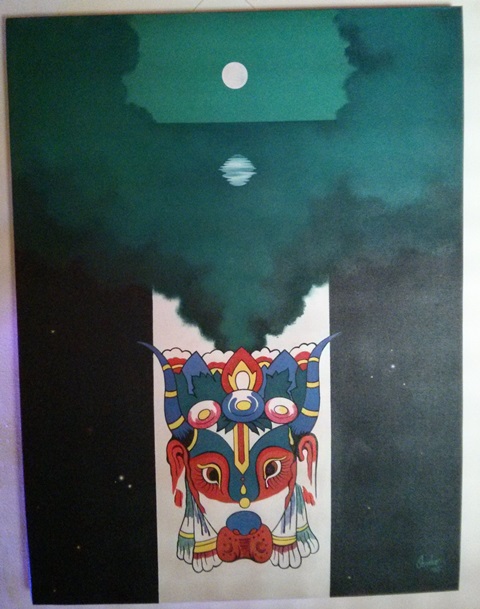
Connection from Religious to Spiritual by Shankar Son Shrestha
Arjun Khaling’s There is Time to Talk has three distinguished guests covered in colourful pins from countless events. It suggests what the Kalajatra unwittingly hints at – the times they are not a-changing, and politics in Nepal remains the same as ever. Perhaps the most provocative of works, given Harijan’s legacy, is Sheelasha Rajbhandari’s Uncommon Factor. The papier-mâché and paint sculpture is cute; by replacing the Hindu god Vishnu with an ant, the work makes a direct jab at the past. The ant surprises with its finesse and comfort upon its snake bed. Manish Harijan also makes an appearance in the exhibition in Sanjeev Maharjan’s Portrait of the Artist in the Gallery, but the work fails to make a major impression on the viewer. It does little more than document the event, revealing scant little of the artist or of the event that has already swept social media. He also has not really bothered to explore the historical weight the phrase carries.
Aside from the exhibition at Patan Museum, the Kalajatra also hosted a carnival, a cartoon exhibition at Siddhartha Art Gallery, and workshops for artists. As an artistic event, it is so close to what the art community needs and what could, even in the short run, revolutionize the art scene. But it is still disheartening to see good ideas incompletely/lazily thought through. It worries the Dionysian to see how complacent the art world is. But, as any Gai Jatra parade will quickly teach – you live and learn to laugh at life.
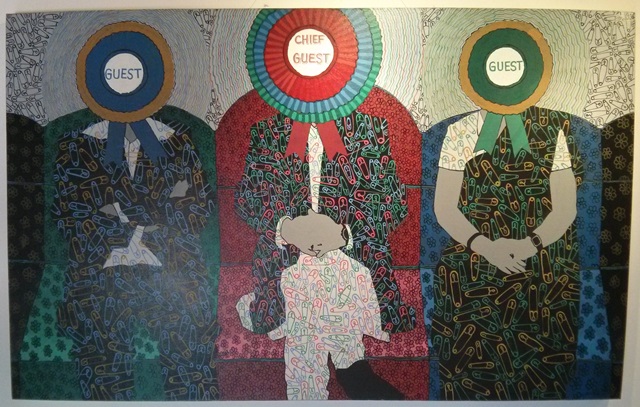
There is Time to Talk by Arjun Khaling
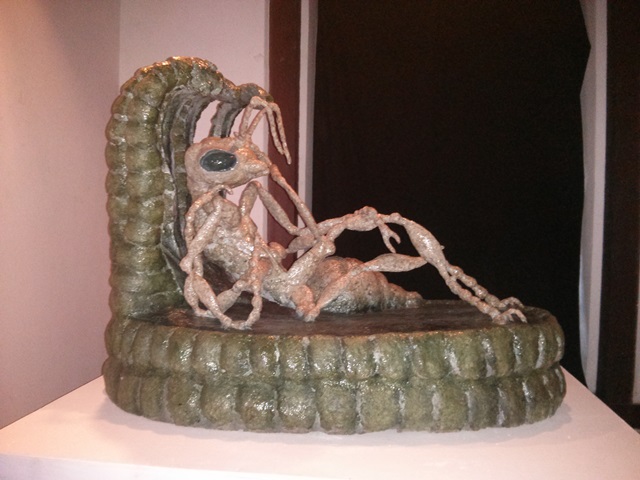
Uncommon Factor by Sheelasha Rajbhandari
_____________________________________________
The Kalajatra exhibition is on till September 6, 2013 in Patan Museum and till September 17, 2013 in Siddhartha Art Gallery.
_____________________________________________
The Dionysian is high spirited, usually on grain-spirit, so his views may rub against the grain of everybody, including the editors of this magazine, who do not necessarily share his opinions.
How do you make a dying tradition relevant? By mimicking the past or by making the past relevant to the present? Kathmandu’s recently held Sa Paru or Gai Jatra festivities proved to be a trial ground for tradition. For the Newar communities that remain and still practice their traditions in the inner city of Kathmandu, the day is very personal. It is a homage to death. The processions, for all their pomp, are in memory of a dead family member. But talk to anyone from the valley, especially stubborn Newars from Kathmandu, and they will tell you the tradition is fading. It remains strong in Patan and Bhaktapur, they will say, but in Kathmandu, the Newar community and its traditions are facing a slow death. In the meantime, Kathmandu’s Gai Jatra has received a boost through the annual LGBT Pride parade. The parade follows part of the traditional route and challenges more traditional theatrics with a blast of absurdity and contemporary relevance drawn from present-day Kathmandu, allowing the festival to retain its importance to a city whose demographics have changed dramatically over the past decade.


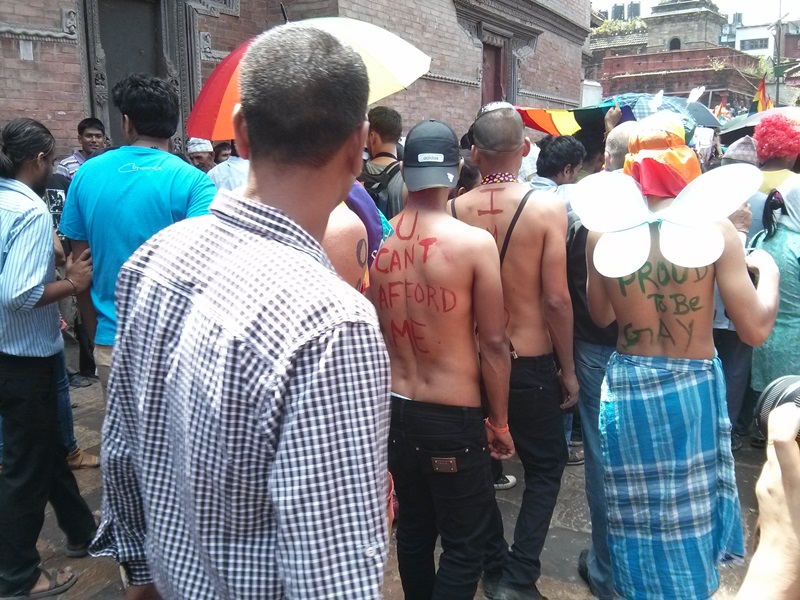

The Pride Parade
The openness with which the festival is approached allows for the LGBT community to come out in all its extravagance. On this day, the inner city is ready for the unexpected. Traditionally a day synonymous with free expression, satire and mockery, whether holding the parade trivializes the LGBT movement or is a soft entry into the mainstream is up for discussion. A more traditionalist standpoint would find it to be a gross misrepresentation of culture, but it is also a reminder that the parade acknowledges death, and Yamaraj hardly discriminates when pulling the plug. The Pride Jatra has also injected some life into an otherwise uninteresting day. As this blogger was chasing the rainbow, it became clear that the mainstream was curious, at the very least. Overheard: “How do you explain it to this one… they are male and female. They are both. Third gender.” “Huh?” “Ah, they are just like us, human beings.” “Ah! Some of them are very pretty.”
Bhupeen and Chaubis Reel
“The essay and poetry are deeply related,” said Bhupeen, “the way I am related to my brother. The blood that flows inside an essay is the same blood that flows inside poetry.” This year, Bhupeen’s essay collection Chaubis Reel was unanimously nominated for the 2012 Uttam Shanti Puraskar, and his acceptance speech at the Nepal Bar Association was beautiful and succinct. The award is given out every year on May 26, the birth anniversary of Uttam Kunwar, to a Nepali writer whose work stands out in the field of literary non-fiction writing.
“This collection is a documentary of an important period of my life,” says Bhupeen in the introduction to Chaubis Reel. “Twenty-four reels of life from the last sixteen years are compiled here.” Using the metaphor of a camera, Bhupeen continues in poetic prose, an aspect of his style that strikes the reader instantly. “The heart and the mind are two existential aspects that manage humans. The heart doesn’t reason, it proceeds by prioritizing influence and experience. The mind reasons. The mind tries to get closer to the truth by way of thesis, anti-thesis and synthesis. For the complete development of civilization, it is important that both of these departments function. As a reader, I like creations that compel humans to use both the heart and the mind. I like essays that don’t just perceive, but also reason.”
Bhupeen ends his introduction by delving into the relationship between poetry and the essay: “Poetry gives linguistic strength to the essay, as well as art and style. It adds beauty to the essay’s aspect. The essay furnishes poetry with the roof of thought. I always feel that it is not enough for any creation to be merely beautiful, it should also be powerful. Since art adds beauty and thought adds strength both of these are expected in every creation.”
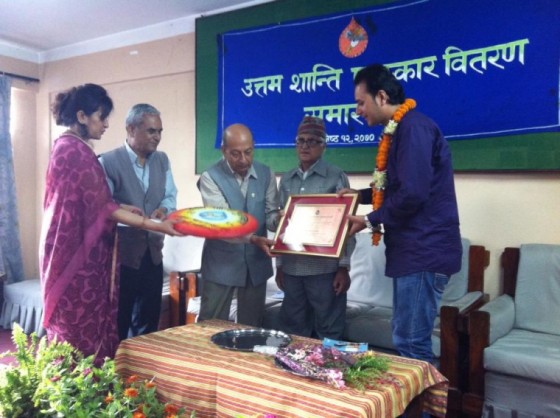
Bhupeen receiving the Uttam Shanti Puraskar (Sudeep Thakur)
Apart from essays that are inherently poetic, Chaubis Reel is noteworthy for its breadth and depth, for the ground the writer covers. Bhupeen gracefully makes his way in and out of several genres, ranging across the travelogue, the personal narrative, political commentary and psychological inquiry. The collection stands out, in part, because the essays are difficult to categorize in their entirety. At one point Bhupeen will draw you in with his descriptions of Silguri and at another, he’ll urge you to dream.
“Dreaming is probably the most attractive and mysterious experience in life,” he writes in his first essay, “Poet and Dream”. An exploration of the psychological, artistic, historical and political aspects of dreaming follows, with Bhupeen declaring that in this country, politicians stand against the dreams of our poets. “Our miseries began here”, he says, explaining, “History is witness to the fact that in the Roman Era, people’s dreams used to be presented in the senate. There were substantial debates and interpretations of these dreams. But there are no discussions of our poet’s dreams in parliament.” Bhupeen believes that we are saved, in the end, by our dreams. And we have to do something to prevent our country from becoming dreamless.
Uttam Kunwar and Srasta ra Sahitya
Bhupeen’s innovative technique makes him a perfect fit for the Uttam Shanti Puraskar, which was first established by Shanti Kunwar in 1986 to commemorate the lifework of her husband, the late Nepali literary journalist Uttam Kunwar. The award is given to essayists whose work is modern, original, inspiring and personal.
Uttam Kunwar was also the publisher and editor of the monthly periodical Rooprekha, still remembered today as a milestone in the history of literary journals in Nepal. Because of Ruprekha and his own writings, compiled primarily in Anubhav ra Anubhuti (Experience and Sensation) and Srasta ra Sahitya (Author and Literature), Uttam Kunwar forged a unique identity for himself in the history of Nepali essay writing.
Srasta ra Sahitya is a collection of essays based on Kunwar’s interviews with thirty-five prominent Nepali writers. A provocative intellectual and an original thinker, Kunwar transformed the way interviews were conducted, avoiding a simple question-and-answer style. The essays in Srasta ra Sahitya are remarkable because of the way Kunwar has captured each writer’s personality and described his work. Readers get a unique glimpse into the lives of Bal Krishna Sama, Lekhnath Poudyal, Bhupi Sherchan, Parijat and M.B.B. Shah, among many others. Kunwar’s moving accounts are humane, deep and thoughtful. A popular and critical success, Srasta ra Sahitya won the Madan Puraskar in 1966, when Kunwar was just 27 years old.
Srasta ra Sahitya was reprinted this year by the Uttam Kunwar Memorial Award Fund. Here is an excerpt from the publisher’s note to the current edition:
“This book introduces us to Nepali literature and writers of half a century ago. We are confident that it will be read to understand, just as before, the lives and writings, experiences and sensations, personalities and inclinations, stories and sufferings of twentieth-century poets, story-writers, novelists, playwrights, linguists, grammarians, translators, essayists, critics, historians, lyricists, singers, editors, and lexicographers.”
Uttam Kunwar conducted these interviews from 1961 to 1966. He continued his literary work for the next seventeen years, until his sudden and untimely demise in 1982 at the age of 44.

Uttam and Shanti Kunwar at their residence (Madan Puraskar Pustakalaya)
“Do you still have the energy? Hasn’t your enthusiasm been exhausted yet?”, a friend asked Kunwar when he went to talk to him for the fifth time regarding Rooprekha. Writes Kunwar, “When I heard that, I took it as a casual remark. But later, when I thought deeply about it, I realized that hidden inside his remark was an extraordinary sentiment. I remember, I started frequenting these writers’ houses about two decades ago in order to collect writings. I’m still doing it. I’m not doing it just for the sake of writing, I’m doing it for the paper, for advertisements, for sales and for marketing. I don’t consider this an inconvenience; I do it because I want to. If I considered it an inconvenience, people would not remark on my enthusiasm.”
Shankar Lamichhane and Sirish ko Phool
Bhupeen cites Shankar Lamichhane as one of his biggest influences. “With their stream of consciousness style, Shankar Lamichhane’s anarchic writings added a new taste to essays,” writes Bhupeen. “The waves he generated in the lake of essays haven’t yet come to rest.” Shankar Lamichhane attracted Nepali readers with a magnetic force to a genre that is considered dry and factual. Lamichhane is one of the thirty-five writers featured in Kunwar’s Srasta ra Sahitya. Here follow translated excerpts from Kunwar’s essay on Lamichhane, dated June 16, 1966:
Situated on a slope in Chhauni, Lamichhane-jiu’s rented house stood all by itself, just like him. In the silence of the night, only our sounds were audible. Now and then it felt like the rumble of trucks on the way to Trishuli attacked our peace, but they left just as they came, so our conversation was flowing merrily along. We were on the ground floor, sitting in the drawing room, Lamichhane-jiu was leaning against the couch and I was leaning against the bookcase. The white-fabric decoration of the room added a certain warmth and auspiciousness to our calm presence.
Kunwar begins by asking the writer about the role he accords to literature in his own life:
“You are involved in various endeavours to support your livelihood, you’ve seen many ups and downs, sometimes here, sometimes there. But there’s no resolution as yet. Do you still consider life worth living? If you do, is it because you consider life to be worthy of a struggle or is it because of your responsibility towards your offspring?”
“I never put such a big question to my life. I enjoy living and I enjoy the struggle even more. That leaves family – family, you can’t live with or without.”
“It brings us back to the same point. To put it simply, are you living for the sake of the struggle?”
“I’ll answer you simply, too. Life is a struggle. Without it, life is just a constricted vision suffering within the bounds of a cage.”
“What is the relationship between your life-struggle and literature? How do you think it should be?”
“I keep these two separate. The struggle is my life, and literature? Literature is my hobby. I never let either of these two get on top of the other. Yes, sometimes I enjoy the association between these two.”
“So for you, literature is limited to being a hobby? It has never been more than that? Could it ever be more than that?”
“In Nepal’s history to date, literature has never been a profession … That’s why I’ve accepted it as a hobby. As for the refrain that literature should serve, form society’s beliefs, and develop one’s country, I have never been able to believe that.”
…
“So you haven’t taken literature seriously?”
“Yes, why take literature seriously? I haven’t taken even my own life seriously to this day. I was born as a result of my father and mother’s pleasure and I am going to die to give pleasure to millions of tiny organisms; there is no room for seriousness. And if I embrace seriousness in writing, who is going to read my writing?”
Shankar Lamichhane dabbled in various genres – fiction, non-fiction, science fiction, poetry and the memoir, but he is mostly remembered for his essays, particularly his controversial preface to Parijat’s Sirish ko Phool. Asks Kunwar:
“You were accused of taking advantage of Parijat’s fame, showing too much pride and either according Parijat undue importance or not giving her the importance she deserved. What do you have to say about this?”
“I feel that the novel is a big achievement of Nepali literature … a preface to a big achievement has to be big … It’s possible that subconsciously I felt that I was about to do something big, so I might have come across as conceited in parts … controversy is a sign of a novel’s success; otherwise Nepal’s literary world is such that no one gets discussed, a couple of people sit in a corner and gossip, and only a few pieces see the light of publication. And Parijat is the first woman to inspire debate in Nepal. In this regard, she is thanked.”
“In the preface you wrote ‘The future also belongs to Parijat.’ You must be planning to write a historical novel better than Parijat’s Sirish ko Phool. In this way, you are about to snatch away the future that you yourself gave to Parijat. Now, either you refuse to stand by that sentence or if you write a novel, you make sure it’s not better than Sirish ko Phool, right?”
“No, Parijat and I work in entirely different areas and the other thing is that in literature, whoever possesses the present has a future that cannot be appropriated in the same form except through imitation … I do not aim to snatch away someone’s future by imitating them.”
Kunwar and Lamichhane discuss literature, sexuality, the role of sex in literature and vice versa, and hover around religion. Lamichhane says he only worships things that he sees with his own eyes. When it comes to religion, he says, he likes Buddhism the best, particularly its emptiness.
“You just said that you like emptiness. Maybe that is what you were trying to express in your preface to Sirish ko Phool? Perhaps you remember that once, when we were talking after reading Ayn Rand’s Atlas Shrugged, you said you appreciated her purposefulness?”
“I didn’t write about it, did I? … America is in its boyhood and its purpose hasn’t been formed; hence, there’s a need for purposefulness there. I read Ayn Rand’s book as an American and agreed with it. In our old country, where there are thousands of gods, scores of religions, and dozens of philosophies, many objectives have been revealed … that’s why we’ve tended to favour our country’s youngest philosophy, which is emptiness. In the future, if a new way emerges and I’m still alive and like it, if you come over and interview me in the same way, it’s possible that my answer will be different.”
…
“Let’s leave this web of words. Religion, sin, sex, philosophy, and so on – do you think they are important for literature?”
“There is nothing as close to humans as literature. Religion, sin, sex, philosophy, and so on, in their realistic and fantastical forms, are all things that humans initiated. Literature in its entirety is a pure reflection of humanity. All the things mentioned above are parts of literature, but literature is not a part of anything. If you ask me what the definition of a soul is, I will give you a one-word answer: literature!”
Writer and Literature
At the end of May, I stepped into the Nepal Bar Association to attend the award ceremony for the Uttam Shanti Puraskar. I had mixed feelings. Having lived abroad for over a decade, I had turned my back on Nepal and Nepali literature. But Bhupeen’s words shone a light on those parts of my heart and mind that had remained in the dark for a long time. After the function, I was eager not only to read Chaubis Reel, but also to learn more about Uttam Kunwar’s life and his work.
The following day, I took a microbus to Ratna Park and made my way through the cluttered alleys of Bagh Bazaar. A friend had reminded me that the famous bookstore, Ratna Pustak Bhandar, was hidden somewhere in this neighbourhood. But I came across another bookstore first, Shangri-La, and easily found copies of Chaubis Reel and Srasta ra Sahitya. Coincidentally, Shangri-La had taken on the responsibility of distributing the current reprint of Srasta ra Sahitya.
It’s true what Lamichhane said: “Nepal is an old country.” The Nepali language is old. And in another chapter of Srasta ra Sahitya, Balkrishna Sama pontificates that human civilization may have reached its peak at one point in Nepal, nestled in the lap of the Himalayas: “An environment as pure, cooling and natural as Nepal’s Himalayas that inspired the creation of the Vedas can’t be found in any other country.”
Yes, Nepal’s past is ancient, its present complicated and its future uncertain, but Sama’s words may be a bit far-fetched. “Just like a coin has two sides, Sama-jiu’s view also has insights and faults, or, let’s say it plainly, truth and lie,” writes Kunwar.
I didn’t know how fluently I would be able to make my way through these Nepali books, because these days I mostly spend my time reading and writing in English.
By the end of the day, I found myself immersed in these works of literature; the thoughts were strong, the craft, beautiful. I saw a reflection of my own humanity, I did. I also came across working definitions for my soul. A process started. My imagination was ignited. A fire started burning inside me. I began to write.
I wrote for hours and deep into the night. I wrote for friends who might enjoy Bhupeen and I wrote for unknown people who might come across my English words and be inspired to read Kunwar’s Nepali. I wrote because I sensed a larger urgency tugging at me – the urgency to pave a path to the cottage that is Srasta ra Sahitya, inside which live thirty-five of Nepal’s prominent litterateurs. Many Nepali people may have heard about this cottage, they may know how to get there. But there is a danger that a growing number of Nepalis, and people scattered all over the world, may never hear about it, let alone walk down this path.
Niranjan K. enjoys writing, reading picture books and working with primary school teachers. He can be reached at metronir@gmail.com
An off-white ceiling fan coated with grime, probably installed during colonial times, whirred noisily as it spat a hot, dry ga
An off-white ceiling fan coated with grime, probably installed during colonial times, whirred noisily as it spat a hot, dry gust that burnt wherever it touched bare skin. Suppressing a sudden impulse to scratch his groin, a tall, thin man in his early twenties – dressed in a shabby white vest and dusty brown shorts fraying at the seams – opened his mouth to speak in a loud, grating voice.
“If women were mangoes,” Sharad Sinha lamented, “…then she was an Alphonso.” He sighed audibly, stared at a framed photo of a girl placed nearby, and dramatically pressed a cheap cigarette to his chapped lips. “The Jumbo 747-200 of my Romantic-Life Airline exploded mid-air…moments before it was to safely land at the airport of the Democratic Republic of Marriage. The gory, mangled remains of my heart’s black box cry in silent pain…”
Sharad sighed again and continued morosely, “I feel like Voldemort…for she…along with that asshole boyfriend of hers…with each passing day…destroy the horcruxes of my love, which I had concealed all over my subconscious…killing newer parts of me I never even knew existed…” He clasped the photo to his chest, traced her outline with his finger, and angrily rasped, “We are now but Gollum…robbed of our precious by that unworthy hobbit…we must have it back, yes, we must! We wants it, we needs it. Must have the precious. They stole it from us. For she is…my precioussss…”
Sharad’s voice became a frightening squeal and he started pounding the table till Abhishek Singh, taller and dark-skinned with a nasty gash across his left forearm, looked up from his book, pushed back his plastic chair, and turned back to squarely face him.
The two men grudgingly shared a cramped, fourth floor apartment. The shabby room they were in was covered in a fine layer of dust and smelt of marijuana, sweat, and rum. Posters of a few Hollywood divas clung to the dilapidated walls with an uneasy bravado as flakes of yellow paint peeled off. The room comprised two metal cots covered with unwashed sheets, a pair of swaying study tables, a small, bug-infested wardrobe, and a dying potted plant in a corner.
“Now what?” Abhishek barked, fed up of Sharad’s daily whining. This was the last straw. Now it was no longer funny, just plain irritating.
“What?” Sharad shrank back, hurt, and replied with the due caution of a man who knows what’s coming next.
“Weren’t you already over her?” Abhishek shot back. He could no longer tolerate his heartbroken room-mate’s poisonous negativity. He was preparing for an important competitive exam and wanted to stay focused and positive. Babysitting his depressed room-mate was the last thing he wanted to do.
Sharad kept mum for a few seconds before replying, “Can the Earth ever get over the sun?”
Abhishek shook his head vehemently. “Oh please! Let it go man. She has moved on! While you were pining for her, she was with random men but you…”
“And she should have. I am happy for her…It’s that day of the fortnight when she prefers to have Thai food. I am sure he would have taken her to a nice Thai place today.”
“If you really are happy, then you will let her go…and move on yourself. Why do you always have to think about what she is doing with her new BF at this moment? Stop torturing yourself!”
“I can’t move on. I love her. I always will. You know that bhai,” Sharad choked.
Abhishek clucked sympathetically. “But… Why? She is not coming back. What is the use of such love? Focus on your career.”
“Did Arjun ever think so?” Sharad replied laconically.
A frankly puzzled Abhishek stood up, went to his bed, and slowly sat down. “Arjun? Arjun who? If you are referring to that jerk from third year then…”
“No no! I mean the Arjun!” Sharad shot an imaginary arrow into the distance.
“Oh that Arjun!” Abhishek reached for a pillow, folded it, and thrust it under his head. He could see the slowly rotating blades of the fan and he felt time had slowed down. “How does he come into the picture now?”
“Remember what he was told?”
“Enlighten me,” Abhishek sighed in exasperation.
Sharad placed a hand over his heart, bent low, and sermonized in a slow, clear voice, “Karmanye Vadhikaraste, Ma phaleshou kada chana…”
“What the hell…” Abhishek wriggled in bed. “How is this even related to you?”
A slow, faint smile tugged at Sharad’s lips. “Loving her is my dharma. Whether she loves me back or not, whether she returns to me or not, is irrelevant. She may come back, she may not, what truly matters is that I do my dharma of loving her and expect not the fruits of my labour.”
Abhishek looked stunned, and managed to mutter after a few seconds, “You need help, dude. I mean, professional help.”
Sharad, always ready with a retort, dreamily mumbled, “She is my help. I need her.”
Abhishek decided he was going to shift ASAP. He had no desire to stay with a man who could enter his “K-k-k-kiran” phase anytime – just because he had been dumped by his first girlfriend.
“You cannot have her. She doesn’t want to be with you. It takes two to tango, boy. And now, when she is gone, all you can think about is her.”
“So what do you think I should do?” Sharad asked, teary-eyed.
“Move on, damn it!” He had an exam coming up. He should be studying in the library, not debating existentialism with a psychotic, obsessed jerk. How he wished he had chosen to go to university today, instead of staying back to catch up on sleep. He was stuck now, but still, he knew his depressed friend needed his counsel.
“Move on!” Abhishek repeated through gritted teeth.
“And how exactly do you propose I do that?” Sharad spoke again, his voice calmer this time.
“Well, stop thinking about her, for a start. And stop loving her.”
“I cannot! She’s still my best friend!”
“Be your own best friend first,” Abhishek spat, “Hate her for a while, if it helps you heal. Cut all contact, till you become less toxic towards yourself. Some things aren’t meant to be!”
“But…”
“No buts…” Abhishek gestured as if chopping the stale air with his bare hands, “Let me get this straight. She likes you, but even she cut you off for some time after the break-up, and tried to hate you so that she could move on…it worked. She moved on. And now she’s back in your life…this time as a friend, but it is dragging you down!”
“She is back because she’s still my best friend and because she wants to help me move on!” Sharad defended her.
Abhishek could never understand how men, good men, could become such emotional wrecks, simply because of a failed romance. Had they nothing to worry about other than love? What about their career, parents, duties, obligations? He swore to himself in disgust. He hated such spineless, shallow fools.
Surprisingly, the conversation had awakened a dull pang in his heart, one that he hadn’t felt for a long time now. Unknown to all, Abhishek too had been a victim of love once. Or the exact opposite. A long time ago, Abhishek had been in love, but the girl was too sweet for him. He had been a paranoid, hypocritical, and possessive jerk. He’d bossed the girl around, forbidden her from seeing her male friends (while he himself shamelessly flirted with other women), and demanded all her attention be focused at him. One day, she had asked him to meet her parents. He had refused, citing his financial situation. He needed to focus on his career. Marriage was the last thing he wanted at that stage, he told her.
Desperate, she had persisted, but he had refused to see her point. Consequently, she had broken up with him and cut him out of her life. Before he knew what was happening, she had married a school-mate, an engineer-turned-banker settled in the US. There was no more contact between them. Frankly, Abhishek did feel bad in retrospect, but he had not allowed it to get to him. Instead, he had learnt to hate the woman. He woke up every morning and swore he would make the bitch pay for being such a gold-digger. Couldn’t she have waited a few more years? Abhishek thus became more career-oriented; he stopped fraternizing, and worked harder to become professionally successful. He was almost on the verge of success. The exam was next week.
He came back to the present, realizing that not everyone was as strong as him. He needed to go soft on Sharad. After all, this was his first heartbreak.
Abhishek sucked in a deep breath, opened his mouth, and tried to drill sense into his semi-crazed friend. “Everyone suffers setbacks in love, yaar, but eventually they embrace it. At some point you have to accept that she is with someone else and not coming back. Let her be. And most importantly, let yourself be. This self-abnegation is not going to help anyone! Know this – you would have been unhappy with her…”
“I know,” Sharad mumbled.
“Hang on,” Abhishek’s mouth dropped, “You know you would have been unhappy with her? And still you do this to yourself?”
“I know I would be unhappy with her,” Sharad muttered sadly, “…But without her, I’m unhappier.”
Ah. I should have known, thought Abhishek. “You’ve lost it man. Yes you have.”
Sharad did not respond. Instead, he lapsed into an uncomfortable, incomprehensible silence. He stared at a point on the wall, unblinkingly, and started to move his head in perfect circles. It seemed to Abhishek that he had finally reached Sharad and this was just the fucked-up manifestation of him coming to terms with reality. A self-congratulatory grin lit up his face. But then a scream jerked him back.
“Abhishek! Got it!!”
Abhishek raised a skeptical, alarmed eyebrow. “Got what?”
“Green waves! Multiverse!”
“Green waves? Multiverse? What the fuck, dude?”
Sharad spoke like a man possessed. “You see… Everett’s Many World Interpretation of Quantum Mechanics states that anything that can happen, does happen, and in doing so creates a new time-line, a new universe, within the multiversal continuum that develops independently from that point onwards…”
“I am familiar with Everett,” Abhishek replied, his tone a mixture of exasperation and curiosity. “But how does it apply to you?”
“See, she may have left me in this universe, but out of the infinite number of universes within the multiverse, there will be at least one such universe in which she is still with me! In that world, she never leaves me in the first place and we grow old together! In which I do not suffer a heartbreak! I just need to connect to the Sharad Sinha in that universe somehow…and somehow create a conduit to transfer my happiness from that universe to this…if I can initiate contact with the me in that universe then…”
“Then…” Abhishek cut in, “I’d ensure that the you in that universe would never meet Pooja in the first place!”
“Kya yaar!” Sharad replied, visibly hurt, even angry at having this idea challenged and distorted.
Abhishek pretended not to hear him. “I hope you find a way to contact the you in that universe where Pooja never bumped into you at the Xavier’s fest! That would make you live in peace in this universe at least.”
“Still, the fact remains that in at least one universe within the multiversal continuum Pooja does stay with me…”
“What does it matter, Sharad?” Abhishek tried to counter quasi-logic with concrete logic, “She no longer loves you in this universe. She’s with someone else. Someone she finds better. Imagine her thinking about her new BF…half of the time you think about her!”
Sharad stopped speaking, stung by the ramifications of this line of thought. He muttered something under his breath, lunged for a sketch pen, and jumped to the wall next to his bed. With swift strokes, he started drawing.
“What are you doing? NO! Not on the wall!”
Sharad paid no heed and kept scribbling till the yellow wall was even dirtier than it had been. He was done in a few seconds.
“A sine graph?” Abhishek exclaimed, unable to contain himself.
Sharad nodded serenely as if this was the most natural thing.
“But…why? What?” Abhishek was at a loss for words.
Sharad smiled self-assuredly. “Because this represents modern love.”

“And pray tell, how an analogy between a sine graph and a modern romantic relationship would proceed?”
“Tell me, what does a sine graph contain?” Sharad asked professorially.
“Yes…umm…Okay…The sine graph has angles on the x-axis and values on the y-axis.”
“If we take time (t) as the x-axis and love (l) as the y-axis, then this is how a normal, average relationship proceeds. People fall in love at t=0, and then the quantitative and qualitative value of love keeps on increasing till it reaches the point of maximum love. From then on, love starts to diminish, either due to familiarity breeding contempt or the gradual expiration of the honeymoon period. Then it reaches equilibrium for a brief period of time as the modular quantity love becomes zero…”
“And then?” Abhishek asked, genuinely interested now.
“And then, we enter quadrant IV. The zone of negative love,” Sharad declared.
“Negative love?”
“Negative Love. You can call it Hate.”
“Ah! But shouldn’t negative love be indifference instead?” Abhishek queried.
Sharad stabbed the wall with the tip of the sketch-pen and shook his head. “Indifference is neutral. It represents zero – no physical entity, no presence. But love and hate do exist. They represent a whole, modular presence, which, ipso facto, cannot be zero. Love and hate are the two sides of the same coin. Only their signs change…and with it, their very purpose and meaning.”
“Okay, go on…”
“Negative love, or hate, continues to rise with respect to time, till it reaches a point of maximum hate. Then on, either due to maturity, or some other factors such as nostalgia, desire, indifference, or an attempt to revert to an earlier stage, hate starts to decrease until another equilibrium point is reached.
“And then…”
“Let me guess!” An excited Abhishek jumped up, “Thus begins another cycle of love-hate in the conjugal relationship!”
Sharad nodded zealously, leaned back in his chair, and slapped the table in response.
“So what if she hates me now? Or that she loves someone else? According to this graph, she will one day begin loving me back again and start hating the other guy who she currently loves. Moreover, the sum of love remains constant in this universe. Thus, if she’s not with me, then she’ll be with someone else. Still, the total amount of love mankind receives will remain constant, for love can neither be created nor destroyed, only transferred from one object to another. I just have to wait for my turn!”
“Indeed.” Abhishek opened his mouth in wonder as he realized that the shit flowing out of Sharad’s mouth actually made sense, even if from a senselessly twisted perspective. He thought for some time, scratched his head, and asked, “But I cannot get two things, Sharad. I know you’re comparing sine to love. You have mentioned the sine values but you have not specified a scale for the other analogy you’re trying to draw. I know quantifying love might be problematic, thus you haven’t given the y-axis a numerical basis, and rightly so. But why doesn’t the x-axis in the analogy have numerical values?”
“Let me ask you. What is there on the x-axis in our analogy?”
“Time,” Abhishek replied without thinking.
Sharad counter-questioned. “Precisely. Can we quantify time?”
“Of course we can. But you still haven’t…”
Sharad replied as if talking to a child. “I have not allocated temporal reference points on the x-axis to denote the time it takes for love to transmute into hate and vice versa, simply because this cycle of love-hate-love varies from couple to couple. For some, this cycle may be completed in 1 month. For others, in 10 years. In others, 50! It all depends on mutual chemistry. By not quantifying time, I have created a universal graph that can be applied to all couples!”
“Hmmm…” Abhishek nodded in agreement.
“You wanted to ask a second thing?”
“Yes…How is this graphical representation connected to your case?”
“Didn’t you want me to stop thinking about her?” Sharad asked sharply, “Didn’t you want me to move on?”
“Er…yes of course. But how…” Abhishek was surprised at the aggression that had crept into Sharad’s tone.
“Don’t you get it,” Sharad screamed, his eyes brimming with tears, “…the only time I do not think about her is when I think about random, crazy shit.”
Sharad started to sob.
Abhishek didn’t know what to do. It was the first time a bro had lost it in front of him. It was positively unnerving and made him quite uncomfortable. He inched towards Sharad, patted his shoulders, and gave him a bottle of lukewarm water.
Sharad looked up at him, his eyes still watery, and pressed the water bottle to his lips. He sat back and closed his eyes.
“Are you okay?”
Sharad smiled weakly. “Thank you, Abhishek. I feel better now. You are right. All this relationship crap is futile. We should focus on our careers. What is the loss of one girl? There are thousands of others – if you have the right mindset and the right bank balance!”
Abhishek could do nothing but stare at him. Hearing his own words made him feel a bit uncomfortable. Love and hate are the two sides of the same coin.
“There is no The One. If one girl goes, you’ll find another. I was a fool to waste my tears over her. Thank you Abhishek. I am over that woman…!” Sharad said triumphantly.
The statement pinched Abhishek. There is no The One.
“I’ll find someone else who loves me as much. To hell with her! I am liberated now!” Sharad concluded.
I’ll find someone else who loves me as much.
Once more, Abhishek was transported back in time. Inexplicably, the dam burst. He recalled her bespectacled face, and realized how happy he had been with her. He could never forget the way she looked at him when she thought he wasn’t looking – her expression a mixture of pride, adoration, and longing. Abhishek sniffed. With thoughts of her came her maddening, intoxicating fragrance. He missed it, badly. He remembered how her eyes lit up when she saw his texts. How she cooed a jovial “Hello!” whenever he called her. How she stayed awake at night waiting for his messages when they quarreled. And above all, he remembered the empowering feeling he had every morning upon waking up: a feeling of completion, of joy, of pride, at knowing that there was someone in this world who loved him unconditionally. How had he repaid her? By being a jerk.
Abhishek, from the corner of his eyes, saw Sharad smile, reach for a textbook, and open it. He looked much better. In another few minutes, he looked completely healed – the poison was out of his system. He was immersed in mathematical calculations. It seemed as if he had forgotten about Abhishek’s presence in the room.
His eyes started to water. He had let the love of his life get away. His temples throbbed, ferociously. He got up from the bed, darted around for his sandals, and slipped them on. He staggered to the balcony and felt the warm breeze kiss his face. He smelt her perfume in the air, just as Sharad began to hum a cheerful Bollywood song.
Abhishek cursed out loud. He felt a tear stream down his three-day stubble. Angered at his own weakness, he punched a chipped brick in the red balcony wall. The impact was hard enough to generate a loud crack, but it was drowned out by another sound – his weeping. Abhishek gasped for air and prayed it was the blow that had caused the tears.
Sami A. Khan’s debut thriller Red Jihad won the “Muse India Young Writer (Runner-Up) Award” at the Hyderabad Literary Festival 2013 and “Excellence in Youth Fiction Writing” award at Delhi World Book Fair 2013. He is now working on a sequel. He can be reached at sakhan1607@gmail.com.
ust that burnt wherever it touched bare skin. Suppressing a sudden impulse to scratch his groin, a tall, thin man in his early twenties
The Kingdom at the Centre of the World: Journeys in Bhutan, by Omair Ahmad, Aleph Book Company, 2013
We have come to expect production values from Aleph Book Company, and The Kingdom at the Centre of the World: Journeys in Bhutan does not disappoint with its delicately rendered cover of a dzong suspended, as it were, in time and space. Nonetheless, it is the stated mission of author Omair Ahmad to tether the mystery of Bhutan to the mainstream of the wider world, and he begins by name-checking milestones on the road to Thimpu – the introduction of Buddhism by Padmasambhava in the 8th century, the state’s consolidation in the 17th century, its fraught relations with Tibet, China and British India, the refugee crisis of the 1990s, and the latter-day curiosities of Gross National Happiness and guided democracy.
But Ahmad is not dealing in serious history here. He opts instead for a more palatable hodgepodge of folklore, journalism and travelogue, divvied up into sections too brief to do their subjects justice. He devotes two early chapters to assorted saints who put Bhutan on the map; it’s frustrating that a book that means to enlighten us on Bhutan finds it necessary to subsist on a mash-up of mythology and recorded history. Ahmad’s easy, anecdotal style has its advantages, but it leads him to such lazy paragraphs as that summing up the 11th-century mystic Milarepa: ‘The idea of a man at peace with himself in the wilderness, subsisting on wild roots and attuned to Buddhist principles must have held great appeal to the Buddhists of Bhutan, enclosed as they were by jungles and mountains. It is little surprise that the Drukpa school of Buddhism soon began to dominate the country. Milarepa’s songs are considered amongst the greatest repositories of Buddhist knowledge ever produced.’ There is no real examination of why the Drukpa school dominated in Bhutan or why Milarepa’s songs are so profound, so one is forced to conclude that Ahmad is projecting his own pastoral longings onto mediaeval Himalayan peoples.
However, the simplicity with which Ahmad outlines Bhutan’s religious and secular evolution serves some purpose, and the reader begins to grasp the difficulties the tiny kingdom has faced throughout its miraculous survival in a rough neighbourhood. Ahmad also, by recounting the invention of the suspension bridge in Bhutan and the tea-fuelled Duar Wars with the British, manages to posit the country as less isolated, if not quite the centre of the world. Perhaps he is too enthusiastic: he is very keen to portray Bhutanese protagonists as heroes, and his disapproval of British colonial Ashley Eden, for instance, is undisguised and petty.
If unbiased historical analysis is not Ahmad’s forte, however, we have a right to expect real insights into Bhutan’s character, earned through hard miles off the beaten track. Instead we are served up with vignettes of a few tourist sites, supplemented with weak anecdotes culled from previous visitors. Is the writer being disingenuous when he claims that as a political advisor in New Delhi in 2005, he found ‘almost no concrete information about the country’? Bhutan may have been an enigma to many, but scores of tomes dissecting its history were published prior to Ahmad’s discovery of the country that ‘sounded too good to be true’. Perhaps he is trying to convince us that information was scarcer than it was, so as to present his own travels as more adventurous than they actually are?
Slowly, one begins to realise that Ahmad’s exploration of Bhutan has not led to special insights beyond state-approved platitudes. To his credit, he does have a go at setting the scene for the inevitable discussion of ‘the Nepali issue’. He inserts a chapter on Sikkim to justify Bhutan’s anxiety regarding its independence and national character, followed by another on the 1950s conflict with the anti-monarchy Bhutan State Congress. There is a further section on the Tibetan refugees who passed through the kingdom before Ahmad works up the nerve to address the question of the Lhotsampas, the ethnic Nepalis who comprised a third of Bhutan’s population before approximately 100000 left to become refugees in Nepal from the late 1980s onwards.
Ahmad describes the escalation of conflict between overzealous but non-violent state authorities seeking to implement nationalistic ordinances and violent Lhotsampa revolutionaries, and suggests that those ethnic Nepalis who doubted their ability to cope left while many others stayed on. One senses that Ahmad is trying to be balanced, but in supporting the hypothesis that the vast majority of those in the refugee camps were actually Nepalis from Nepal and India, he risks sounding like an apologist for ethnic cleansing, not least when he dismisses activist Tek Nath Rijal’s account of his decade-long incarceration in Chamgang jail, which allegedly employed mind control techniques, as ‘something from the X Files’.
Refugees dispensed with, Ahmad moves on to an admiring account of the Fourth King’s development philosophy, detailing how he abdicated in favour of his son and guided the country to democracy. En route, he offers this remarkable justification for Bhutan’s homegrown indicator of development, Gross National Happiness. The consequences of unhappiness are to be seen everywhere, Ahmad declares. Look at Kashmir in India, Sikkim, and Nepal. Even East Pakistan (Bangladesh) split from West Pakistan because of unhappiness. Bhutan has taken note of this trend, he concludes. Once more, there is no analysis of what Gross National Happiness might offer as an alternative to Gross National Product, merely the banal claim that Bhutan has decided to prioritise the happiness of its citizens. But which state in history has not claimed to have the interests of its citizens at heart?
It is this simplistic view of things, finally, that leaves those seeking a solid depiction of Bhutan disappointed. For all the book’s claims, Ahmad perceives little more than your average, informed tourist, despite connections that get him invited to places and spaces the former would not have access to. This is not the definitive book on Bhutan you have been waiting for: it really is just one man’s journey.
Nepalikukur may be apprehended here.
What do Narayan Wagle, Yug Pathak, Narayan Dhakal, Krishna Dharabasi and Buddhisagar Chapain have in common? They are all Brahmin males, of course. But they are also the authors of contemporary Nepali-language novels that have garnered uncommon critical and commercial success, and as such they formed the inspiration for ‘Five Nepali Novels’, a keynote address by Michael Hutt to mark the Annual Kathmandu Conference on Nepal and the Himalaya 2013 (24-26 July).
Judging by the impressive turnout at Hotel Shankar’s ornate Kailash Hall, the rather less decorated edifice of the Nepali novel is of interest precisely because the aforementioned high priests of Nepali literature are so far from elitist. A longish exposition of the novels’ plots by Hutt informed us that Pretkalpa (Dhakal), Radha (Dharabasi) and Urgen ko Ghoda (Pathak) rely on a reinterpretation of religious mythology to advocate radical change in Nepali society. In Palpasa Café (Wagle) and Karnali Blues (Chapain), too, the protagonists make parallel journeys out of their comfort zones – one from the indulgences of Kathmandu to the Maoist heartland, the other from the hinterland of Karnali to the big city. All the novels address poverty, exclusion and discrimination to some degree, though only Karnali Blues is content with “showing”. In this, Chapain reinvents the familiar Nepali variant of social realism, leaving his more Marxist contemporaries to thrash against the limitations of socialist realism. Wagle achieves a sort of post-modern playfulness; it is no surprise then, as Hutt notes, he was vilified by certain leftist commentators for his “bourgeois” non-committal to the cause.
Despite their real or imagined failings – Hutt suggested that the conflation of authors with protagonists on the part of both authors and readers was problematic – these novels, collectively, are seen to represent a significant movement in Nepali literature. Especially through the use of meta-narratives drawing on the past, they articulate not only what we are, as a nation of diverse peoples, but also what we are not, yet. With the deployment of modern marketing strategies (notably with Palpasa Café and Karnali Blues, which sold in the tens of thousands) and a crossover between socialist and bourgeois fiction that appeals to a growing, increasingly literate readership, the potential for Nepali writing to influence the Nepali conscience is strong, according to Hutt.
But what of the world? The inevitable question on the place of the Nepali novel in global literature duly arrived, and was significant for being addressed to Hutt, who has probably done more than anybody to introduce Nepali-language literature to the West. Have we made it yet, the student holding the microphone seemed to be wondering, Can we be famous for more than accidents of history and a bunch of risible Guinness World Records? Fortunately, the audience was prepared to laugh at this very Nepali anxiety, and Hutt was diplomatic enough to say that it was language barriers, more than anything else, that was holding Nepali literature back. As if to illustrate the point, another student jumped up to demand, in garbled fashion, “What is the role of language in society, politically, socially, economically?” Thrown by the non-specificity, Hutt requested in Nepali that the question be repeated. A mortifyingly encouraging chorus of “Nepali ma bhannus!” followed, and, permission to articulate in the vernacular granted, the student essayed the question again: “Language ko role ke ho society ma?” At which point moderator Abhi Subedi, losing patience perhaps with the absurdity of both question and questioner, raised his hand and grinned, as he adjourned the session, “Yes! Language has an important role in society!”
Nepalikukur may be apprehended here.


